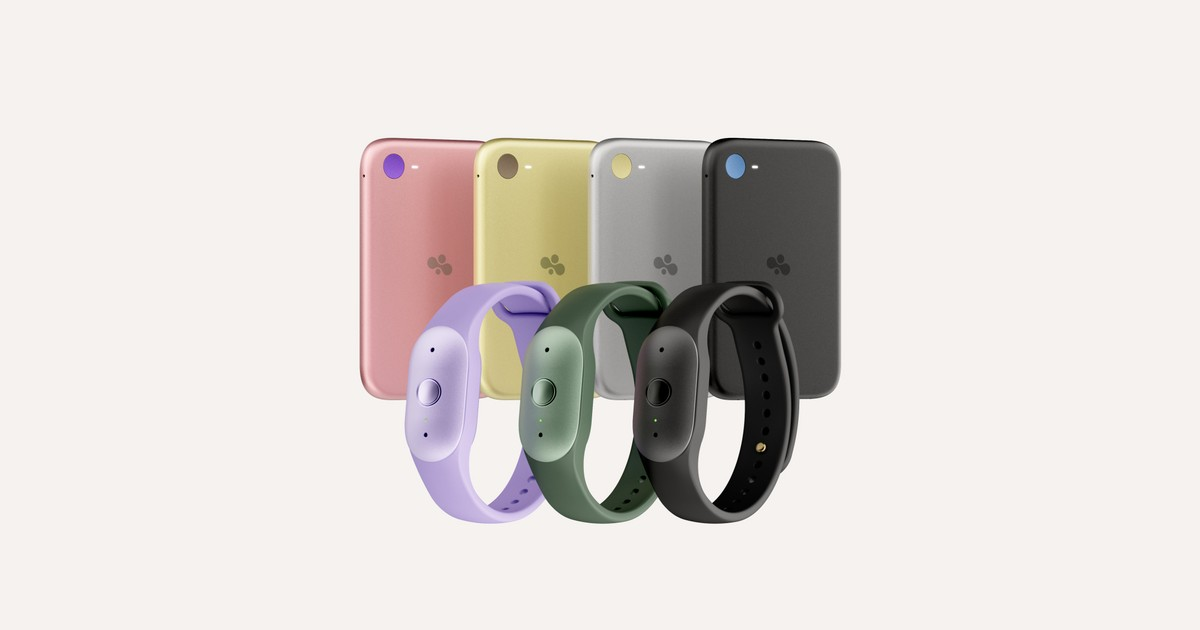
Header image: Bee Eclipse in four colors behind Bee Frontier in three colors. Image: Amazon.
Disclosure: some links below are Amazon affiliate links (tag cao04-20). Costs you nothing; the picks are the same either way.
Note: Amazon announced Bee Frontier and Bee Eclipse on October 15, 2026, the day before this was written. Frontier is on sale now; Eclipse is listed as “Coming Soon.” Prices were checked on Amazon on October 16, 2026. No independent reviews exist yet, and Amazon’s listings show no customer reviews; everything below is based on Amazon’s own posts and listings and early reporting.
Amazon Bee is Amazon’s line of always-listening AI devices: you press a button, it listens to your conversations, and it turns them into summaries, to-dos and reminders. This week Amazon added two new ones. Bee Frontier is a $74.99 band you wear on your wrist or clip to your shirt. Bee Eclipse is a $99.99 credit-card-sized device that snaps onto the back of your phone and, unlike Frontier, can process both sides of a phone call.
For a solo operator or a small shop, the pitch is obvious: meeting notes, client call recaps and follow-up emails without propping a second phone on the table. The catch is just as obvious. A device that listens to everyone in the room is a consent question before it’s a productivity question.
This guide covers the difference between the two, what the free tier gets you versus the $11.99-a-month Bee Pro plan, what Amazon’s privacy claims do and don’t cover, and when a phone app is the better answer.
Amazon Bee Frontier vs Eclipse: the short answer
- You want notes from in-person meetings, site visits or a counter: Bee Frontier ($74.99). It’s available now, it’s IP67-rated, and it’s the cheaper way to find out if you’ll actually use this.
- Most of your client work happens on phone calls: Bee Eclipse ($99.99, coming soon). Amazon lists it as the one that processes phone calls, and Frontier as the one that doesn’t.
- You need meeting notes from video calls on a laptop: you may not need hardware at all. Phone and desktop note-taking apps such as Otter and Granola do this with no extra device.
- Your work involves clients who’d object to being recorded, or you’re not sure of your local consent rules: don’t buy either until you’ve sorted that out.
What Bee actually does
Amazon describes Bee as personal AI that “remembers what matters from your conversations.” When it’s on, it listens, transcribes, and turns what it heard into summaries, to-dos, reminders and insights (Amazon). You read the results in the Bee mobile app or a new desktop app, with templates for different kinds of conversations; Amazon’s examples are lectures, care plans and brainstorms.
The business-relevant part is the integrations. Amazon says Bee connects to Gmail, Google Calendar and Microsoft Outlook, and after a call or meeting it can surface action items, draft follow-up emails, or create calendar invites based on what was said. It can also connect to Apple HealthKit and your photos. Bee’s own product page lists “manages professional meetings and client interactions” among its uses (Bee).
CNBC notes that Amazon’s Echo speakers were designed to listen only after a wake word, while Bee devices are always recording when turned on (CNBC). You control the “on.” Both devices start and stop with a single button and show a light when they’re running. Bee’s Frontier page says that by default the microphones turn off after a period of silence, and you can set that timeout anywhere from 5 minutes to 24 hours.
The first Bee device, the Bee Pioneer, was a $49.99 wristband. Amazon bought Bee in July 2025 for an undisclosed price, and these are the first new Bee devices under Amazon’s ownership (GeekWire).
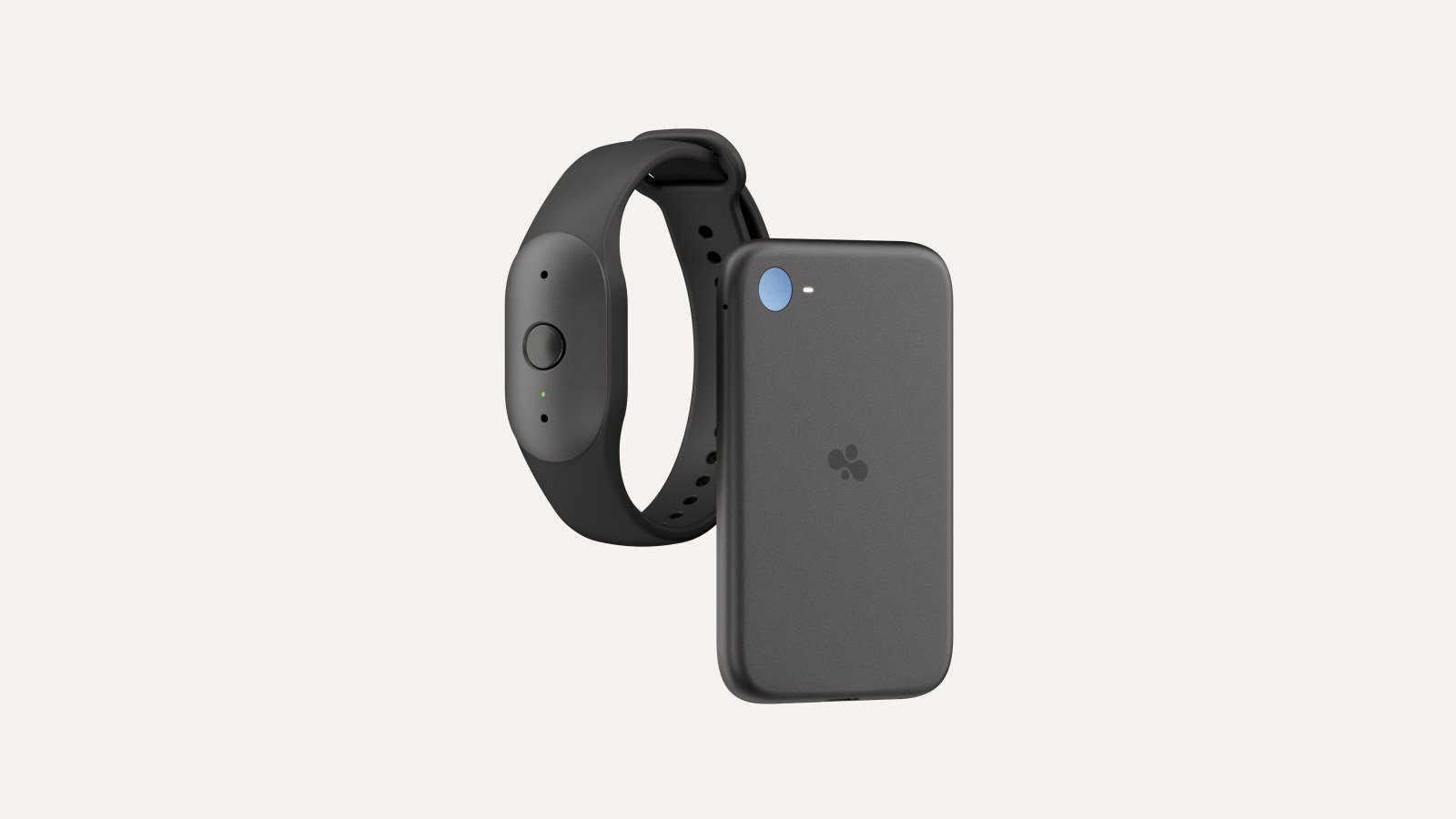
Bee Frontier (left) and Bee Eclipse (right). Image: Amazon.
Frontier vs Eclipse: the spec differences
From Amazon’s comparison table on both listings, plus Amazon’s announcement and Bee’s pages:
| Bee Frontier | Bee Eclipse | |
|---|---|---|
| Price | $74.99 | $99.99 |
| Availability | On sale now | ”Coming Soon” on Amazon |
| Form factor | Wristband or clip | Magnetic phone attachment, MagSafe-compatible |
| Size | 36 x 19 x 13.4 mm | 56 x 85.6 x 4.6 mm |
| Microphones | 2 MEMS mics | 4 MEMS mics plus a vibration microphone (VPU) |
| Phone calls | Not listed | Processes both sides of a call |
| Battery | Up to 7 days (Bee says up to 160 hours) | More than 21 days |
| Water resistance | IP67 | Not listed (N/A) |
| Amazon’s “best for” | Everyday use, outdoor use | Phone conversations, professional environments |
| Colors | Onyx, Lavender, Sage | Silver, Midnight, Honey, Blush |
Sources: Bee Frontier on Amazon, Bee Eclipse on Amazon, Amazon, Bee.
Bee Frontier: the wearable
Frontier is the updated version of the original Bee band. The Verge says the recording button is more prominent than on the previous model and that it now comes in three colors (The Verge). The box includes the device, a wristband, a clip and a start guide, so you can wear it or pop it out and clip it to a belt or pocket.
Amazon says the dual microphones have advanced noise filtering for places like “a crowded restaurant or open office.” It charges over USB-C and is rated IP67, which Bee describes as “rain, sweat, sink splash.” The single button does three things: a press starts or stops it, a long press saves a voice note, and a double press bookmarks a moment so it’s easier to find later.
Frontier makes sense if your important conversations happen in person, standing up: a contractor walking a job, or an owner meeting a supplier.
Bee Eclipse: the phone attachment
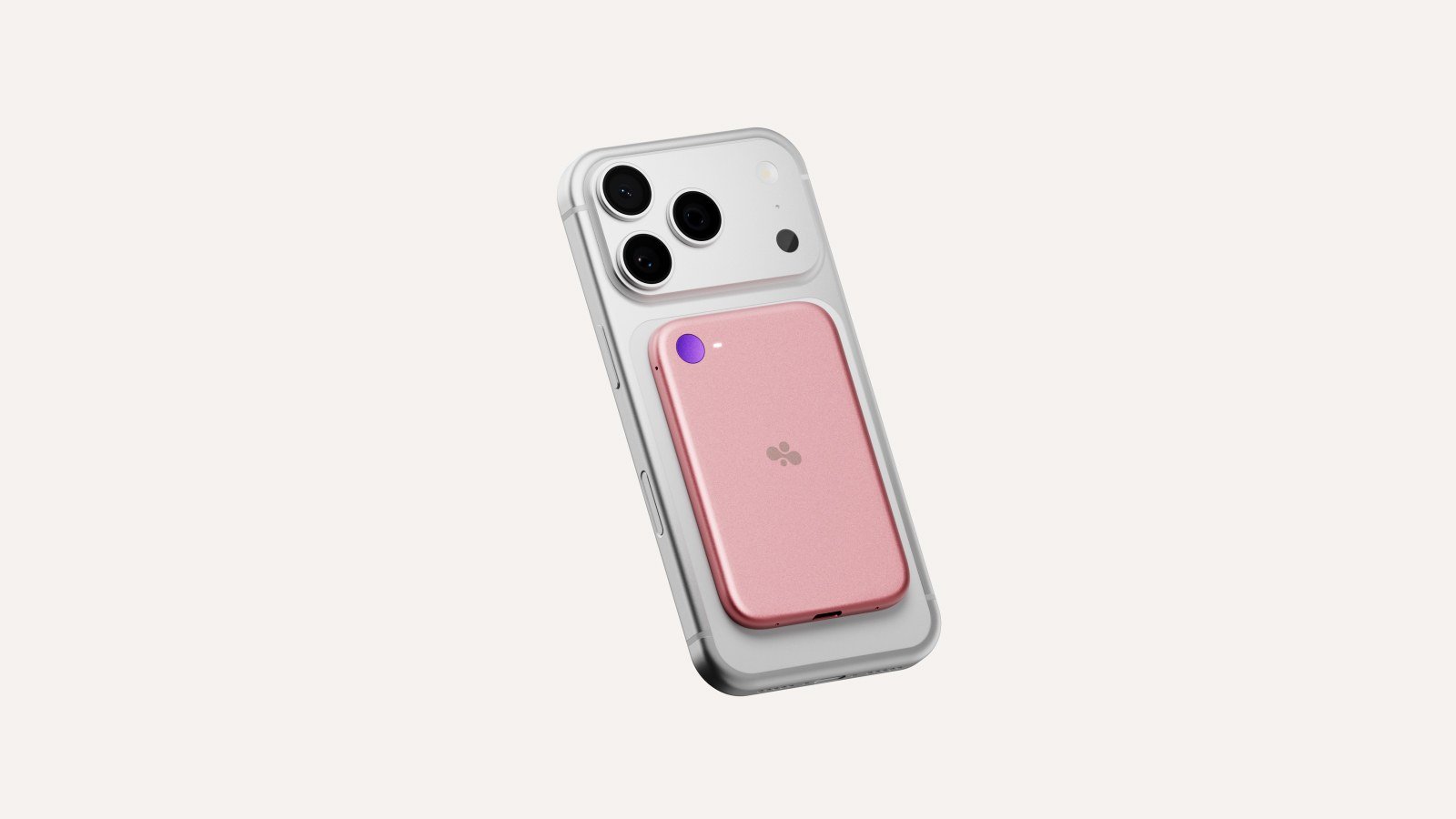
Bee Eclipse in Blush on the back of a phone. Image: Amazon.
Eclipse is the new shape. It’s about the size of a credit card, 4.6 mm thin, and attaches magnetically to the back of your phone. Bee calls it MagSafe-compatible, and the Amazon listing says it snaps on with an included magnetic accessory. The Verge says Amazon envisions it for more professional use cases, and that the bigger body allows a bigger battery.
The important difference is calls. The Eclipse listing says it “recognizes both sides of every phone call using a vibration microphone,” while four MEMS mics pick up you and the people around you. Bee’s Eclipse page says it processes both sides of a phone call when you start it. Frontier’s Amazon comparison table doesn’t list phone-call processing.
There’s no water-resistance rating listed for Eclipse. If you work outdoors or around water, that’s a point for Frontier.
Eclipse isn’t on sale yet. Amazon says it “will be available soon” and hasn’t given a date.
Free tier vs Bee Pro
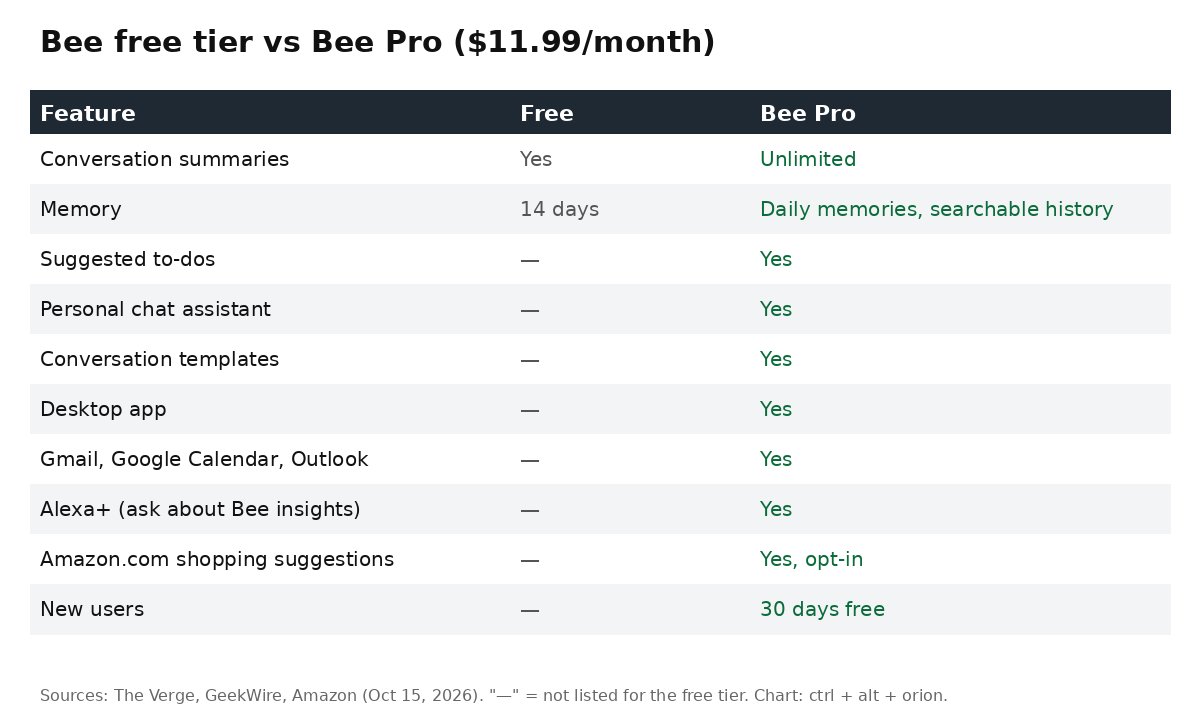
What the free tier and Bee Pro include, per The Verge, GeekWire and Amazon. Chart: ctrl + alt + orion.
The devices work without a subscription, but the features a business would buy them for mostly don’t.
Free: The Verge says the free tier gets conversation summaries, recaps and 14 days of memory. GeekWire describes it the same way: summaries plus 14 days of memory.
Bee Pro: The Verge puts it at $11.99 a month; GeekWire and CNBC round it to $12. Per The Verge, Pro adds “unlimited” summaries, suggested to-dos, daily memories, a personal chat assistant, conversation templates, third-party app integrations, and the desktop app. GeekWire says most of the extras, including the desktop app and third-party integrations, require Pro. Amazon’s listing says Pro gives you a searchable database of every conversation.
Pro is also where the two headline integrations live:
- Alexa+. Connect Bee to Alexa+ and you can ask an Echo for a meeting summary or your to-dos. Amazon says your Echo uses voice ID to recognize you before giving you your Bee insights.
- Amazon.com shopping suggestions. This one is opt-in. If you connect Bee to Amazon.com, things you mention in conversation can show up as product recommendations on the Amazon homepage and in the Bee apps. Amazon’s example is the dish soap you said you’d buy; The Verge’s is cat litter your spouse asked for. GeekWire notes the feature won’t happen unless you connect your Bee account to Amazon.com.
New users get 30 days of Bee Pro free.
So the real business price is the device plus $11.99 a month, or $143.88 for twelve months of Pro.
Our advice for a shop: leave the Amazon.com shopping connection off. It’s a consumer feature, and there’s no business reason to have a client’s offhand mention turn into a product card on your Amazon homepage.
What Amazon’s privacy claims cover
Amazon leans hard on privacy, and the claims are specific, so it’s worth reading them closely.
According to Amazon, both devices run on what it calls Bee Private Compute:
- No audio is stored. Amazon says audio is processed into insights in real time and deleted after processing. The Frontier listing adds that it is “never stored to disk or file.”
- Encrypted transcripts. Transcripts are encrypted with keys that only your device creates and controls, and they’re accessible only to you unless you choose to share them.
- Isolated processing. Amazon says conversations are processed in “a secure and isolated processing environment where no one, including Amazon, can access your data.” Bee’s page says all generative AI processing runs in Amazon’s isolated environment with no access from external providers, and it lists Sigstore public ledgers for integrity checks.
- Deletion. You can delete transcripts and summaries at any time.
Those are real promises, but they’re about you and Amazon, not the person across the table. Your client’s words still become a transcript, a summary and a set of to-dos in your account. The Verge reports that Bee’s AI is trained on your voice at setup, and other speakers aren’t automatically identified unless they agree to let Bee train on their voice too. Their words are still captured.
The consent problem for a small shop
Here’s the plainest statement in any of Amazon’s materials. On the Eclipse listing, Amazon writes: “Laws vary by U.S. state and country; some require all-party consent. It is the user’s responsibility to inform participants and obtain consent. Bee does not determine consent requirements on your behalf.”
Amazon says Eclipse prompts you to get permission from call participants each time a recording starts. That’s a reminder, not consent. You still have to actually ask, and the other person still has to agree.
In general terms, recording-consent laws come in two flavors. Some places let you record a conversation you’re part of without telling anyone. Others require everyone in the conversation to agree. The rules can also differ for phone calls and in-person conversations, and for calls between places with different rules. We’re not going to list which states fall where; check the rules for where you and your clients actually are, and talk to a lawyer if your business depends on recording.
What that means in practice:
Tell people, every time. “I use a device that takes notes on our conversation. Is that okay?” If they say no, press the button and turn it off. The green light helps here, because they can see that it’s off.
Coworkers count too. If you run a two-person shop, your employee is a participant in every conversation the device hears. Agree on the rules in writing: when it’s on, when it’s off, and who can read the summaries.
Some conversations should never be captured. Anything with health, legal or financial details about a client, or anything covered by a confidentiality agreement, is a reason to keep it off. Bee offers templates like “care plans,” but that’s a consumer example, not a compliance claim.
Don’t leave it running at the counter. It hears customers who never agreed to anything. Turn it off when the meeting ends.
Watch what goes into the integrations. Once Bee drafts emails in Gmail or Outlook, summaries of client conversations are moving into other services. We covered how this kind of data leaks in your staff’s AI prompts piece, and the same thinking applies here.
If an AI tool is going to draft and send things on your behalf, the question of what it’s allowed to do on its own matters too. Our agent liability checklist walks through that for small businesses.
Bee vs phone apps and other AI recorders
Bee isn’t the only way to get meeting notes. GeekWire puts its competition in two groups.
AI note-taking apps on a phone or computer. GeekWire names Granola and Otter as apps that work on a phone with no extra device. If most of your meetings are on video calls from a laptop, an app is the simpler fit, because the conversation is already on the computer. If most of your conversations are in person or on the phone, a dedicated device like Bee has the advantage of not needing your phone out on the table.
Other AI recorders and pendants. GeekWire lists Plaud, Omi and Friend. The Verge compares Bee to the Plaud NotePin and Limitless AI; CNBC mentions Plaud’s card-shaped note-taking device and Friend’s AI necklace. GeekWire also reports that Meta bought Limitless in December 2025 and unveiled the Muse Charm, and that Apple announced Siri Recap, an opt-in conversation summary feature for its new Apple Watches, set to arrive in beta later this year.
We haven’t tested any of these against Bee and won’t guess at their prices or ratings. The honest difference is form: an app costs nothing in hardware, while Bee costs $74.99 or $99.99 up front and suits places where a phone on the table is awkward.
One point in Bee’s favor for an Amazon household: the Alexa+ connection. If your shop already has Echo devices, asking one “What are my Bee insights from yesterday?” is a feature an app can’t easily match. If you’re weighing an Echo for the shop, we compared the current smart displays in our HomeView vs Echo Show vs Nest Hub guide.
Our take
We haven’t tested these ourselves. Bee Eclipse isn’t shipping yet, Frontier went on sale October 15, and neither Amazon listing shows a customer review. There are no independent reviews in our sources to base a score on, so we are not giving either device a star rating yet. We’ll rate them once there’s real testing to go on.
Our take: Bee Frontier — not rated yet
The cheaper way to try ambient meeting notes for in-person work, but only after you’ve settled consent.
- Pro: On sale now at $74.99, with 30 days of Bee Pro free.
- Pro: IP67, up to 7 days of battery, and wear it on the wrist or clip it on.
- Pro: Single button with a visible light and a configurable silence timeout.
- Con: No phone-call processing listed; that’s Eclipse’s job.
- Con: The useful business features (email drafts, calendar, desktop app) need Bee Pro at $11.99 a month.
- Con: No reviews yet. Why no rating: there’s no independent testing and no customer reviews to base one on.
Price: $74.99 on Amazon, sold by Amazon, checked October 16, 2026. Not tested by us.
Our take: Bee Eclipse — not rated yet
The better fit if your client work happens on the phone, once it actually ships.
- Pro: Processes both sides of a phone call, per Amazon’s listing.
- Pro: More than 21 days of battery, and nothing to wear.
- Pro: Prompts you to get permission from call participants each time a recording starts.
- Con: Not available yet; Amazon lists it as “Coming Soon” with no date.
- Con: No water-resistance rating listed.
- Con: Phone calls are where consent rules bite hardest. Why no rating: it hasn’t shipped, and there’s no testing or reviews.
Price: $99.99 on Amazon, “Coming Soon,” sold by Amazon, checked October 16, 2026. Not tested by us.
When neither is the right answer
Your meetings are on video calls. A note-taking app on the computer you’re already using is the simpler setup.
You can’t get consent reliably. If your clients walk in off the street, or you can’t count on asking everyone every time, a listening device is a liability.
You handle sensitive client information. Health, legal or financial details are reasons to keep conversations off any recorder.
FAQ
What is the Amazon Bee device? Bee is Amazon’s personal AI that listens to your conversations when you turn it on and turns them into summaries, to-dos, reminders and insights. Amazon bought Bee in July 2025. Bee Frontier and Bee Eclipse, announced October 15, 2026, are the first new Bee devices under Amazon.
What’s the difference between Bee Frontier and Bee Eclipse? Frontier ($74.99) is worn on the wrist or clipped to clothing, has two microphones, up to 7 days of battery and IP67 water resistance. Eclipse ($99.99) attaches magnetically to the back of a phone, has four mics plus a vibration microphone, more than 21 days of battery, and processes both sides of phone calls.
How much is Bee Pro, and what do you get for free? Bee Pro is $11.99 a month (GeekWire and CNBC say $12). The free tier includes conversation summaries and 14 days of memory. Pro adds unlimited summaries, to-dos, the desktop app, integrations like Gmail, Google Calendar and Outlook, Alexa+, and opt-in Amazon.com shopping suggestions. New users get 30 days of Pro free.
Does Amazon Bee store my audio? Amazon says no: audio is processed in real time and deleted, and transcripts are encrypted with keys your device controls. It says processing happens in an isolated environment called Bee Private Compute, where no one, including Amazon, can access your data.
Is it legal to use Amazon Bee in meetings with clients? It depends on where you and they are. Amazon’s own Eclipse listing says laws vary by U.S. state and country, some require all-party consent, and it’s your responsibility to inform people and get consent. Ask everyone, every time, and check your local rules.
When is Bee Eclipse available? Amazon says “soon.” On October 16, 2026, the Amazon listing showed $99.99 and “Coming Soon,” with no release date.
Sources
5 refs- Amazon, “Amazon introduces 2 new AI products from Bee: Bee Frontier and Bee Eclipse” (October 15, 2026): features, battery, IP67, colors, prices, availability, Alexa+ and Amazon.com integrations, Bee Private Compute, Eclipse permission prompt. https://www.aboutamazon.com/news/devices/amazon-personal-ai-bee-frontier-bee-eclipseaboutamazon.com
- Bee, Bee Frontier product page (checked October 16, 2026): in the box, button functions, 40+ languages, up to 160 hours of battery, silence timeout from 5 minutes to 24 hours, privacy architecture. https://bee.computer/products/frontierbee.computer
- GeekWire, Todd Bishop (October 15, 2026): Bee Pro at $12 a month, free tier with 14 days of memory, 30 days of Pro free, opt-in shopping, Bee Pioneer and the July 2025 acquisition, rivals including Plaud, Omi, Friend, Granola and Otter. https://www.geekwire.com/2026/amazons-new-ai-devices-can-listen-to-conversations-and-suggest-things-to-buy-if-you-opt-in/geekwire.com
- CNBC, Annie Palmer (October 15, 2026): always recording when on, versus Echo’s wake word; Bee Pro at $12; Plaud and Friend devices. https://www.cnbc.com/2026/10/15/amazon-bee-frontier-eclipse-ai-devices.htmlcnbc.com
- The Verge, Victoria Song (October 15, 2026): Bee Pro at $11.99 and what it includes, Eclipse for professional use, voice training and speaker identification. https://www.theverge.com/tech/1011475/amazon-bee-frontier-eclipse-price-specstheverge.com
comments
loading comments…
No comments yet. Start the thread.