Header image: smartphones on display stands in a store. Photo: Jason Leung on Unsplash.
Note: Counterpoint Research published its preliminary Q3 2026 smartphone numbers on October 12, 2026, three days before this was written. Preliminary figures can be revised, and one already has been: Counterpoint raised Xiaomi’s Q3 share from 10% to 12% after first publication. The annual forecast cited below is from February 27, 2026.
The memory chip shortage of 2026 has reached your pocket. Global smartphone shipments fell 20% year over year in Q3 2026, the lowest third-quarter level since 2012, according to preliminary estimates from Counterpoint Research. Counterpoint ties the drop directly to “relentless increases in DRAM and NAND prices,” and says phone makers passed those costs on, “driving up global smartphone retail prices by 20% so far in 2026” (Counterpoint).
That’s two 20% figures, and they measure different things. Shipments are down 20% compared with Q3 2025. Retail prices are up 20% since the start of 2026. Both come from the same Counterpoint release.
IDC, another research firm, put the Q3 decline at 22% in its own preliminary estimate, with 255.3 million phones shipped into distribution channels (The Register). Each firm builds its own estimate, so their numbers won’t match exactly. Either way, The Register sums it up as shipments falling “by at least a fifth.”
If you run a small shop, you probably don’t care who won the quarter. You care whether the $250 Android phone you hand to new staff still costs $250, whether the handheld your POS app runs on will be in stock next spring, and whether that spare SSD in your cart will cost more next month. This piece covers what Counterpoint actually published, why AI data centers are part of the story, and what to buy now versus later.
Smartphone shipments in 2026: the Q3 numbers
Counterpoint’s preliminary Q3 2026 data, based on sell-in shipments (phones shipped into retail channels, not sold to customers):
| Brand | Q3 2026 share | Q3 shipments vs a year earlier |
|---|---|---|
| Samsung | 23% | Down 3% |
| Apple | 22% | Down (size not published) |
| Xiaomi | 12% | Down more than 30% (Reuters/CNA) |
| OPPO (incl. OnePlus, realme) | 9% | Down more than 20% |
| vivo | 8% | Down more than 20% |
| Global market | Down 20% |
Shares and the Samsung, OPPO and vivo changes are from Counterpoint. The Xiaomi decline of more than 30% is from Reuters’ report as carried by CNA; Counterpoint’s own page says only that Xiaomi “recorded a significant shipment decline.”
About Xiaomi’s share: Reuters, CNA and Engadget all reported 10%, because that’s what Counterpoint first published. Counterpoint’s page now says the figure “has been revised from 10% to 12%.” We use 12%.
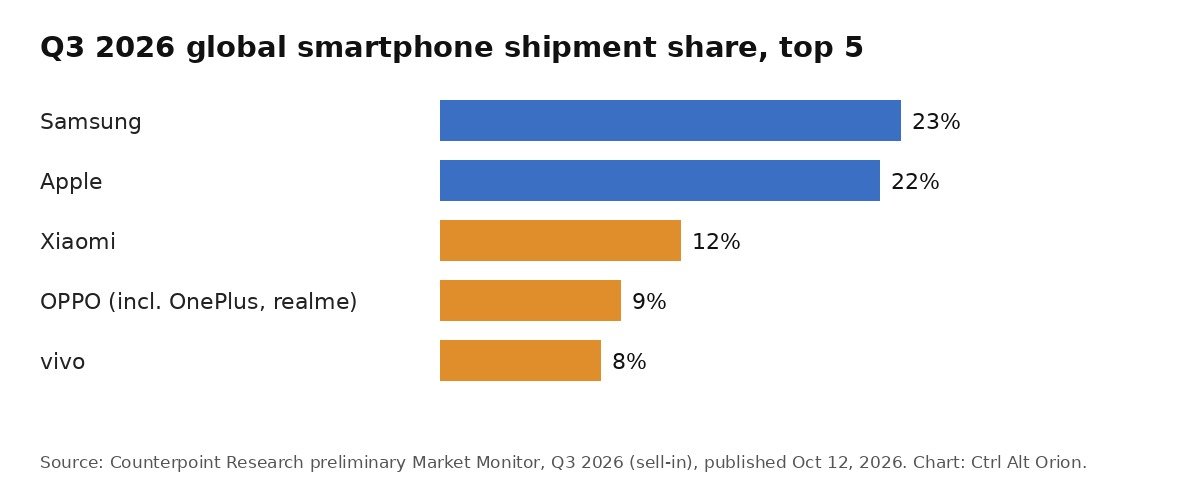 Samsung and Apple together held 45% of Q3 shipments. Chart: Ctrl Alt Orion, from Counterpoint Research’s preliminary Q3 2026 data.
Samsung and Apple vs the Chinese brands
The quarter split the market in two. The two biggest brands lost little volume and gained share. The three big Chinese brands lost a lot of volume.
Samsung shipped 3% fewer phones than a year earlier, but its share rose to 23%, which Counterpoint calls “the largest share gain among major OEMs.” Engadget puts that gain at four percentage points (Engadget). Counterpoint credits “robust initial demand” for the Galaxy Z Fold8 series and “stable component supply” for the mid-range Galaxy A series in emerging markets, where some Chinese brands pulled back.
Apple crossed 20% share in a third quarter for the first time, reaching 22%, even though its shipments fell. Engadget reports the share rose from 18% a year earlier. Counterpoint blames the volume drop mainly on the lack of a base iPhone 18 at launch, which meant a smaller launch-month channel fill than the full iPhone 17 lineup a year earlier. It also notes that Apple “joined the industry wide shift toward price hikes,” though only in the final weeks of the quarter. The iPhone 18 Pro models launched more strongly than their predecessors, particularly in China and India.
Xiaomi, OPPO and vivo took the hit. Counterpoint says Xiaomi deliberately cut exposure to lower price segments and non-core overseas markets, raising prices and tightening shipments “to avoid selling devices at uneconomical margins.” OPPO and vivo both raised prices across entry and mid-range phones. For vivo specifically, Counterpoint says “price hikes pushed budget models out of key price bands, while stock shortages further constrained shipments.” OPPO is consolidating OPPO, realme and OnePlus operations to cut overlap.
Why the split? Counterpoint’s February outlook predicted it: Apple and Samsung “are likely to weather the headwinds better due to stronger supply chain integration, higher pricing power, and continued premiumization” (Counterpoint). Brands that live in the cheap end of the market have less room to absorb a cost increase, so they either raise prices or ship less. In Q3 they did both.
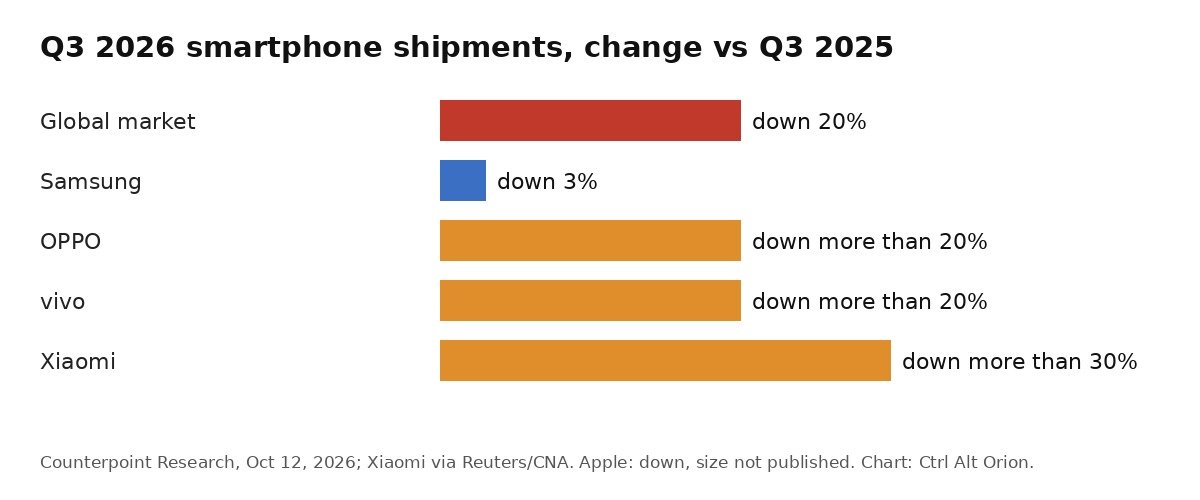 The global drop was driven by the brands that sell the most budget phones. Chart: Ctrl Alt Orion, from Counterpoint Research and Reuters via CNA.
Why phones are more expensive in 2026
The short version is that phones and AI servers want the same memory, and the servers pay more.
Counterpoint’s February outlook spells out the mechanism. Memory manufacturers “continue diverting wafer capacity toward higher-margin AI-focused DRAM and enterprise SSD NAND.” Combined with “prolonged under-investment following the post-COVID correction,” that has created “a multi-quarter supply gap for mobile-grade LPDDR4/5” (Counterpoint). Reuters’ report frames it the same way: AI infrastructure projects are cornering memory supply (CNA).
The sources don’t name HBM specifically. “AI-focused DRAM” is Counterpoint’s phrase, and it covers the high-margin memory that goes into AI accelerators and servers.
The price numbers Counterpoint has published:
- Mobile memory: LPDDR4/5 prices in Q2 2026 were expected to reach “nearly three times the levels seen in Q3 2025” (February forecast).
- Phone prices, early: Counterpoint observed “10% to 20% price increases across some Android OEM portfolios in January 2026.”
- Phone prices, year to date: global retail smartphone prices are up 20% “so far in 2026” (October release).
Counterpoint calls this “fundamentally supply-side in nature.” It isn’t that fewer people want phones. Fewer phones can be built at the old price. That matters for your planning, because a supply problem ends when new factory capacity comes online, not when demand picks up.
How long the memory shortage lasts
Counterpoint’s February forecast is the best timeline published:
- 2026 shipments: down 12.4% year over year, which Counterpoint calls “the sharpest annual contraction ever,” to just under 1.1 billion units, the lowest since 2013. (The same release rounds this to 12% in its summary.)
- Recovery: “unlikely before late 2027,” and dependent on new memory supply coming online.
- Who gets hit hardest: the sub-$200 segment is expected to decline by more than 20%, while premium phones are expected to grow in the single digits. LPDDR4 supply, which cheap phones use, “is shrinking faster than expected.”
- Regions: Middle East and Africa down 19%, Latin America down 14%, Asia Pacific down 14%.
- Longer-term: Counterpoint expects replacement cycles to lengthen “to well beyond four years,” fewer and slimmer product lineups, “higher ASP floors,” and more consolidation as smaller brands struggle.
The October release adds that the rest of 2026 “remains challenging,” and that “a meaningful recovery in overall volumes is unlikely until component costs and supply conditions improve.”
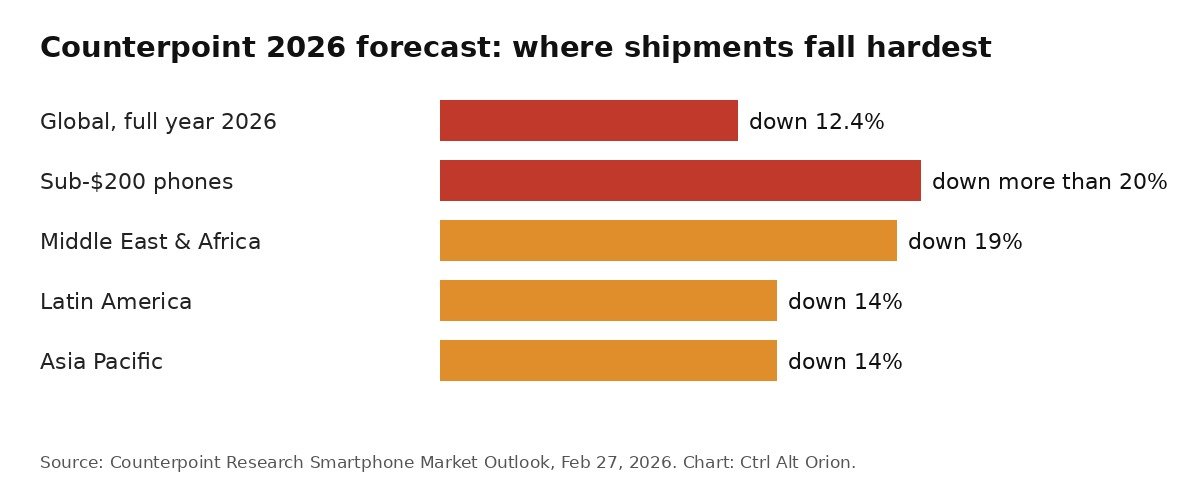 Cheap phones and emerging markets take the biggest hit. Chart: Ctrl Alt Orion, from Counterpoint Research’s February 27, 2026 outlook.
What this means for a small shop
Most small businesses buy phones in two categories: staff phones for calls, texts, authenticator apps and scheduling, and devices that sit next to the register, such as a phone or cheap handheld that runs a card reader, a scanner app or a delivery tablet. Both live in exactly the price range Counterpoint says is under the most pressure.
Here’s how the published facts translate into buying decisions.
Staff phones: buy what you need now, don’t stockpile
Buy now if a phone is failing or you’re hiring. Counterpoint says the downturn runs into 2027 and recovery is unlikely before late 2027. Waiting a few months for prices to fall isn’t supported by any forecast we’ve seen. If you need a phone in Q4, the evidence says buy it in Q4.
Expect the cheap end to get worse before it gets better. The sub-$200 segment is forecast to shrink by more than 20%, budget models are being pushed out of their price bands, and some Chinese brands are cutting entry-level lines and markets. The cheap phone you bought last year may not exist in the same form or at the same price next year. If you standardize on one model for staff, check now whether it’s still being stocked.
Consider refurbished. Counterpoint says consumers are “increasingly considering refurbished devices,” and its February outlook expected the second-hand market to grow in 2026, with sub-$300 used phones looking “more attractive to budget-conscious buyers.” For a staff phone that mostly runs messaging and an authenticator, a refurbished mid-range phone from a reputable seller is a reasonable answer to rising new-phone prices.
Keep phones longer. If replacement cycles are heading “well beyond four years,” plan for it. A new battery and a case on a phone that still gets security updates is cheaper than a new phone at 2026 prices. Before you keep a phone longer, check how long the manufacturer will keep sending security updates. That date, not the hardware, is usually what retires a business phone.
Don’t panic-buy spares. Buying three extra phones “before prices go up” ties up cash in devices that sit in a drawer and lose update years. Buy for the next replacement you know about, not for every possible one.
If you’re choosing a mid-range model right now, our Nothing Phone 3 vs Pixel 11 vs Galaxy S26 comparison covers the options.
POS-adjacent devices: secure the model your software supports
The phones and small handhelds next to your register are the riskiest category, because your choice is limited to what your POS or payment app supports. If that list includes a budget Android model, it’s in the segment Counterpoint expects to shrink most.
- Check availability of your supported model now. If it’s being discontinued or is hard to find, buy one spare while you can, so a broken device doesn’t stop your counter.
- Ask your POS vendor what they’ll support next. Lineups are getting slimmer, so the replacement may be a different model or a higher price tier.
- Don’t buy more than one spare. These devices get software updates and support cutoffs too.
Spare RAM and SSDs: the same squeeze, earlier
PC memory and storage come from the same factories. Counterpoint’s explanation for the phone shortage is that capacity is going to AI-focused DRAM and enterprise SSD NAND, and its October release cites “relentless increases in DRAM and NAND prices.” That’s the same pressure behind PC RAM and consumer SSD prices.
If you have a specific upgrade planned, like doubling RAM in an office PC or replacing a failing drive, the forecasts give no reason to wait. Nothing published here points to falling memory prices before new capacity arrives in late 2027. We went through the PC side in more detail in RAM prices in 2026: buy now or wait and Memory price shock: buy RAM and SSDs before Q4.
The same rule applies as with phones: buy for a known need, not a hypothetical one.
When waiting does make sense
- Your current devices work and get updates. If nothing is broken, nothing forces you to buy at the top of a price cycle.
- You were going to buy premium anyway. Counterpoint expects premium supply to stay “relatively stable.” There’s less risk of a premium phone disappearing, so you don’t need to rush.
- You want a base model that isn’t out yet. Counterpoint notes there was no base iPhone 18 in Q3. If that’s the phone you want, you’re waiting regardless.
Who comes out of this OK
Counterpoint’s read is that the market is moving into what Shilpi Jain called “a more selective phase.” Premium buyers are still buying, and carriers and higher-income customers cushion price increases at the top. Samsung and Apple are gaining share because they can secure supply and charge more.
The people who lose are budget buyers, including small businesses that buy cheap phones in volume. If that’s you, the realistic plan is refurbished devices for low-stakes roles, longer replacement cycles with battery swaps, and new phones only where you need long update support.
FAQ
How much did smartphone shipments fall in 2026?
Global shipments fell 20% year over year in Q3 2026, to their lowest third-quarter level since 2012, according to Counterpoint Research’s preliminary data. For the full year, Counterpoint’s February forecast expects a 12.4% decline to just under 1.1 billion units.
Why are phones more expensive in 2026?
Memory makers are shifting production toward higher-margin AI-focused DRAM and enterprise SSD NAND, leaving less mobile memory. Counterpoint says phone makers passed the higher costs on, pushing global retail smartphone prices up 20% so far in 2026.
How long will the memory chip shortage last?
Counterpoint expects the smartphone downturn to continue through 2027, with recovery “unlikely before late 2027” and dependent on new memory capacity coming online.
Who gained market share in Q3 2026?
Samsung led with 23% and Apple reached 22%, its first time above 20% in any third quarter. Both shipped fewer phones but took share as Xiaomi, OPPO and vivo shipments fell sharply.
Should my business buy phones now or wait?
Buy for needs you know about now; no published forecast points to lower prices before late 2027. Consider refurbished phones for low-stakes roles, and don’t stockpile spares that lose update years in a drawer.
Are RAM and SSD prices affected too?
Yes. Counterpoint cites rising DRAM and NAND prices and capacity being diverted to AI and enterprise products. If you have a planned upgrade, waiting is unlikely to save money.
Sources
5 refs- Global Smartphone Shipments Hit a New Low with 20% YoY Decline, Lowest in 14 Years — Counterpoint Research, October 12, 2026counterpointresearch.com
- Smartphone Shipments in 2026 to See Sharpest Decline on Record as Memory Crisis Deepens — Counterpoint Research, February 27, 2026counterpointresearch.com
- Global smartphone shipments record worst third quarter in 14 years amid memory shortage — Reuters via CNA, October 12, 2026channelnewsasia.com
- Apple’s iPhone market share rose despite a downturn in smartphone shipments — Engadget, October 13, 2026engadget.com
- Smartphone shipments plummet as memory crisis pumps up prices — The Register, October 15, 2026theregister.com
comments
loading comments…
No comments yet. Start the thread.