Header image: the Nothing Phone (3) and its Glyph Matrix. Image: Nothing.
Disclosure: some links below are Amazon affiliate links (tag cao04-20). Costs you nothing; the picks are the same either way. Every spec and test number is sourced at the bottom.
Note: This Nothing Phone 3 vs Pixel 11 comparison was updated October 12, 2026. Samsung raised the Galaxy S26’s US list price to $999.99 on October 1, and the $724.99 sale that was running on October 9 ended on October 10 — Amazon is back at the $999.99 list today. The Pixel 11, which was $749 on Amazon on October 9, is $799 today. The Nothing Phone (3) has been $549 since early October. Prices below were checked October 12 and change often.
When we first ran this Nothing Phone 3 vs Pixel 11 vs Galaxy S26 comparison in August, the pitch was simple: the Nothing Phone (3) cost $100 less than two $899 rivals and beat them on the spec sheet. Two things have changed since then. The prices moved a lot, and the lab tests came in.
The price move helps Nothing. It’s $549 at Nothing’s own US store and on Amazon right now, the Pixel 11 sells for $799 on Amazon against a $899 list price, and Samsung’s Galaxy S26 is back to its $999.99 list price now that the October sale is over. The tests are less flattering. The Nothing’s bigger battery doesn’t last longer, its 65W charging rating doesn’t refill it much faster than the others in practice, and its 4,500-nit brightness claim doesn’t show up as the brightest screen in testing.
So this version of the article answers the question with tested numbers, not marketing numbers. If your phone is also your card reader, product camera, barcode scanner, and backup hotspot, here’s the one to buy.
The verdict: Nothing Phone 3 vs Pixel 11 vs Galaxy S26
- Best value: Nothing Phone (3) at $549. You get the biggest, sharpest screen here, a 50MP 3x periscope, a 50MP selfie camera, and 256GB for $250 less than the Pixel. You give up battery life and two years of Android version updates.
- Best all-rounder: Pixel 11 at about $799. It had the longest tested battery life and the brightest tested screen of the three, it has the longest zoom (5x), and Google promises 7 years of updates. In the US it’s eSIM-only, so check that with your carrier before you buy.
- Galaxy S26: skip at list. It’s the fastest and lightest of the three, and Samsung promises up to 7 major OS updates. The $724.99 sale ended October 10; at $999.99 it costs about $450 more than the Nothing, which is the wrong side of that trade. Wait for the next sale.
For most small operators who want a solid phone for $549, the Nothing Phone (3) is still the pick. If you can stretch to the Pixel 11’s current price, it’s the better phone.
Our take on each phone
These are editorial ratings for a small-business phone, based on the manufacturers’ spec pages and GSMArena’s lab results cited below, weighed against the October 12 price. We haven’t tested these phones ourselves.
Our take: Nothing Phone (3) — 4/5
The most phone for $549, with the biggest, sharpest screen and the highest-resolution cameras. The shortest tested battery life and fewer OS updates keep it at 4.
- Pro: 6.67-inch, 1260 x 2800 screen, the biggest and sharpest of the three
- Pro: 50MP 3x periscope and a 50MP selfie camera
- Pro: $549 for 256GB, with Wi-Fi 7
- Con: 12:56h in GSMArena’s battery test, the lowest of the three
- Con: 5 Android updates, versus 7 years on the Pixel and up to 7 major OS updates on the Samsung
Price: $549 at Nothing’s US store and on Amazon, checked October 12, 2026 (launched at $799).
Our take: Pixel 11 — 4.5/5
The best all-rounder: the longest tested battery life, the brightest tested screen, the longest zoom, and 7 years of updates. It loses half a point for being eSIM-only in the US and the slowest to charge fully.
- Pro: 15:40h in GSMArena’s battery test and about 2,100 nits in its brightness test, both best of the three
- Pro: 10.8MP 5x telephoto, the longest zoom here
- Pro: Magnetic Qi2.2 wireless charging at up to 25W
- Con: eSIM-only in the US, with no physical SIM slot
- Con: Slowest to a full charge in GSMArena’s test (1:20)
Price: $799 on Amazon, checked October 12, 2026 ($899 list at the Google Store).
Our take: Galaxy S26 — 3.5/5
The fastest and lightest phone here, with long software support. It only made sense at its $724.99 sale price, which ended October 10. At the $999.99 list price we’d rate it lower.
- Pro: Geekbench 6 multi-core score of 10,824 in GSMArena’s test, far ahead of the other two
- Pro: 167g, the lightest of the three
- Pro: Up to 7 major OS updates
- Con: $999.99 list, no sale running — about $450 more than the Nothing
- Con: 4,300 mAh battery, the smallest here, and 25W wired charging
Price: $999.99 at Amazon, checked October 12, 2026. Samsung.com’s $724.99 sale price ended October 10.
Nothing Phone (3), 256GB, on Amazon: check current price · Pixel 11, 256GB, on Amazon: check current price · Galaxy S26, 256GB, on Amazon: check current price
Nothing Phone 3 vs Pixel 11 vs Galaxy S26: comparison table
| Nothing Phone (3) | Pixel 11 | Galaxy S26 | |
|---|---|---|---|
| List price (256GB) | $799 at launch | $899 | $999.99 (was $899.99 until Oct 1) |
| Price seen Oct 12, 2026 | $549 (Nothing US store, Amazon) | $799 (Amazon) | $999.99 (Amazon; the $724.99 Samsung.com sale ended Oct 10) |
| Chip | Snapdragon 8s Gen 4 | Google Tensor G6 | Snapdragon 8 Elite Gen 5 (US) |
| RAM / storage | 12GB/256GB or 16GB/512GB | 12GB/256GB or 12GB/512GB | 12GB/256GB or 12GB/512GB |
| Screen | 6.67”, 1260 x 2800, 120Hz | 6.3”, 1080 x 2424, 120Hz | 6.3”, 1080 x 2340, 120Hz |
| Claimed peak brightness | 4,500 nits | 3,000 nits | 2,600 nits |
| Tested brightness (auto) | ~1,500 nits | ~2,100 nits | ~1,400 nits |
| Battery | 5,150 mAh | 4,985 mAh | 4,300 mAh |
| Tested battery life | 12:56h | 15:40h | 15:20h |
| Rated wired charging | 65W | 30W | 25W |
| Tested charge in 30 min | 63% | almost 60% | 62% |
| Wireless charging | 15W | 25W, magnetic (Qi2.2) | 15W (Qi2 Ready, no magnets) |
| Rear cameras | 50MP main, 50MP 3x periscope, 50MP ultrawide | 48MP main, 10.8MP 5x telephoto, 13MP ultrawide | 50MP main, 10MP 3x telephoto, 12MP ultrawide |
| Front camera | 50MP, 4K/60 | 10.5MP, 4K/60 | 12MP, 4K/60 |
| Software support | 5 Android updates, 7 years security (from July 2025) | 7 years OS and security (from Aug 2026) | Up to 7 major OS updates |
| Weight | 218g | 197g | 167g |
| Wi-Fi | Wi-Fi 7 | Wi-Fi 6E | Wi-Fi 7 |
| US SIM | Nano-SIM + eSIM | eSIM only | Nano-SIM + eSIM |
| Water/dust | IP68 | IP68 | IP68 |
Tested figures are GSMArena lab results: battery life is its Active Use Score, brightness is its 75% white-window test in auto mode. The Nothing was tested in July 2025, the Galaxy S26 in March 2026, and the Pixel 11 in September 2026. Bold marks the winner in each row where there is a clear one.
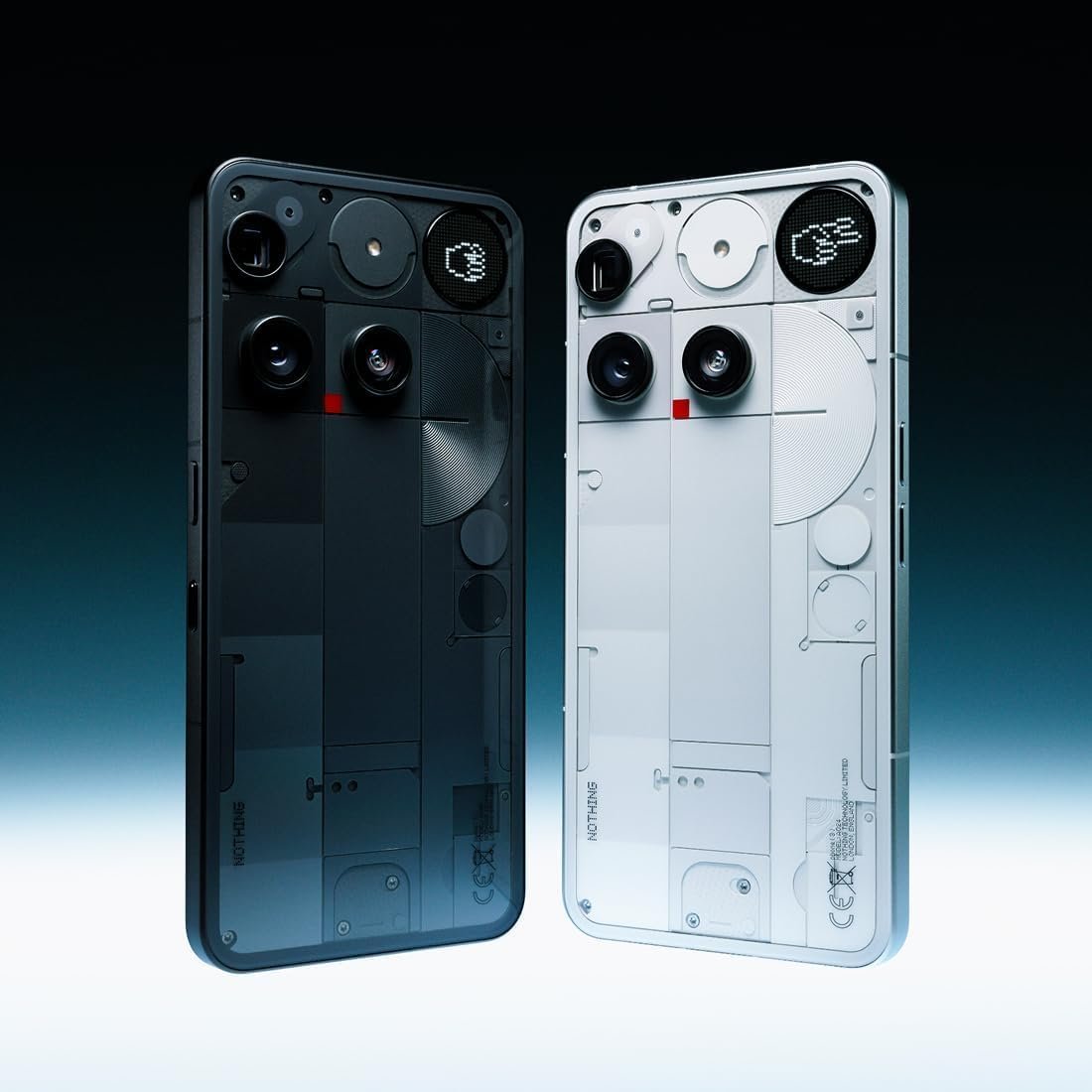 The Nothing Phone (3) comes in black and white. Image: Nothing.
Price: what each phone actually costs this week
This is the row that changed most, and it’s why the Nothing is still worth recommending.
Nothing Phone (3): $549. It launched at $799 for 12GB/256GB and $899 for 16GB/512GB, per GSMArena’s review. On October 12, Nothing’s US store lists the 12GB/256GB model at $549 with a $699 strikethrough, and Amazon has it at $549 too. I couldn’t confirm a current price for the 512GB model, so check the listing before you buy.
Pixel 11: $899 list, $799 on Amazon. Google’s own store still shows $899 for 256GB, or “from $549” only with an eligible trade-in. GSMArena puts the 512GB model at $1,019 list. Amazon had the 256GB Pixel 11 at $749 on October 9; on October 12 it’s $799 — still $100 under list, but the $749 window closed.
Galaxy S26: $999.99 list, no sale running. Samsung raised prices across the S26 range on October 1. The base 256GB model went from $899.99 to $999.99, and the 512GB model from $1,099.99 to $1,199.99. Samsung didn’t give a reason, and 9to5Google blames rising memory costs. Samsung.com was discounting the 256GB model to $724.99 through October 10; that sale is over, and Amazon is back at the $999.99 list with limited stock. If you want an S26, the honest advice is to wait for the next sale window.
So the gap between the Nothing and the Pixel is about $250 at street prices. The S26’s price is just the list price again, which makes it a “when it’s on sale” phone.
Battery life: the biggest battery doesn’t last the longest
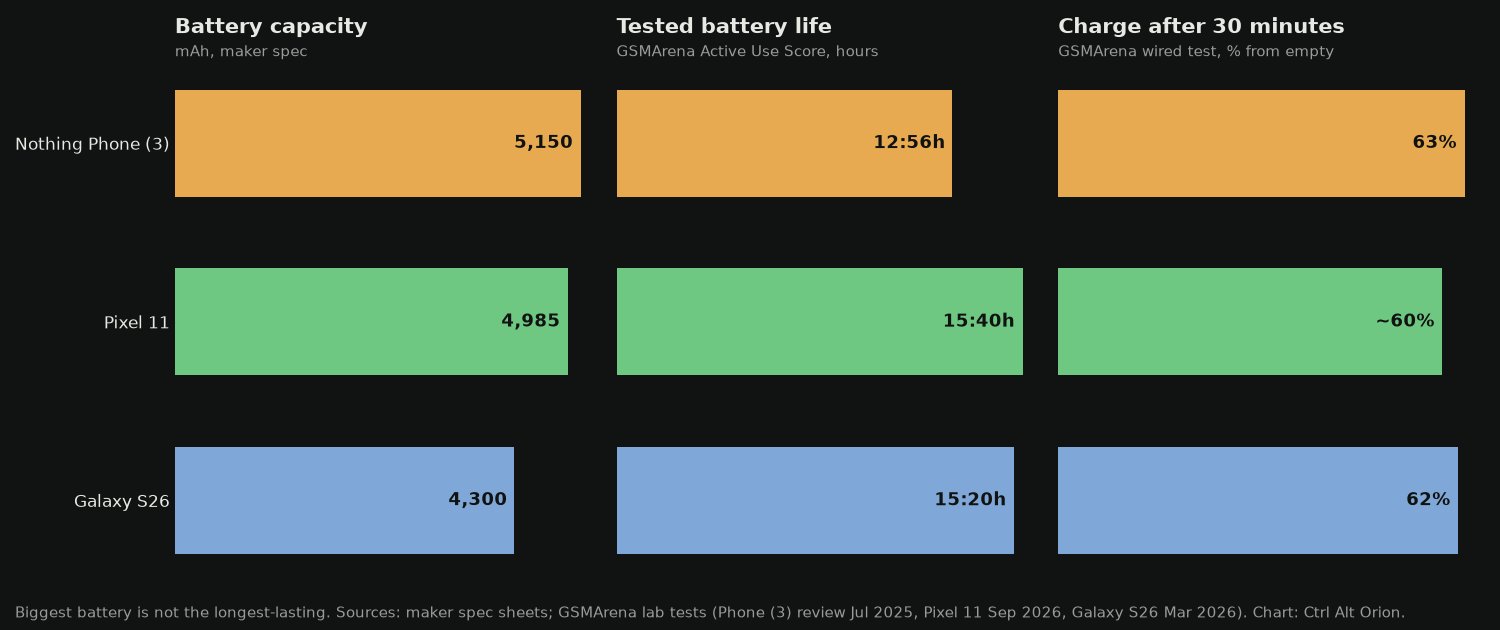 Spec sheet versus lab: the Nothing has the most mAh and the shortest tested battery life. Chart: Ctrl Alt Orion, from GSMArena data.
The original version of this article led with battery, and on the spec sheet the Nothing still wins. It has a 5,150 mAh silicon-carbon cell, compared with 4,985 mAh in the Pixel 11 and 4,300 mAh in the Galaxy S26.
Lab testing tells a different story. GSMArena gave the Phone (3) an Active Use Score of 12:56 hours and called the result “fairly solid, but not overly impressive.” Its explanation is that the Snapdragon 8s Gen 4 “is seemingly just a pretty, power-hungry chip.” The Pixel 11 scored 15:40 hours and the Galaxy S26 scored 15:20 hours, even though the Samsung’s battery is about 850 mAh smaller.
That’s almost three hours of difference in a standardized test. Your hours will differ, since a POS app, a hotspot, and screen brightness all change the result. The ranking is the useful part: in the same lab, the Nothing finished last.
If battery life decides it for you, buy the Pixel 11.
Charging: 65W on the box, a tie at 30 minutes
The Nothing’s 65W rating is more than double the Pixel’s 30W and the Samsung’s 25W. In practice, that gap mostly disappears.
GSMArena charged the Phone (3) with a PD charger rated above 65W and found it “never actually reached anywhere near 65W,” peaking at more like 40W. It reached 63% in 30 minutes and full in 1 hour. The Galaxy S26 reached 62% in 30 minutes and full in 1:04. The Pixel 11 hit almost 60% in 30 minutes and took 1:20 to fill.
So if you plug in over a 30-minute lunch, all three come back at about 60%. The Nothing finishes a full charge a few minutes before the Samsung and about 20 minutes before the Pixel. That’s a real advantage on a long day, but it’s not the big win the 65W number suggests.
Wireless charging favors the Pixel. It has magnets built in and supports Qi2.2 at up to 25W, so it snaps onto a desk or van mount. The S26 is Qi2 Ready but has no magnets, so it needs a magnetic case. The Nothing tops out at 15W.
Whatever you buy, none of these phones ships with a charger. A 65W USB-C PPS charger like the Anker Nano 65W ($29.99 on Amazon on October 12) covers all three at full speed. PPS matters here because the Pixel and the Samsung both need it for their fastest rates.
Our take: Anker Nano 65W GaN II PPS charger — 4/5
Covers the fastest wired charging on all three phones for about $30. It’s rated on its listed specs, not our own testing.
- Pro: 65W USB-C with PPS, which the Pixel and Samsung need for their fastest rates
- Pro: Small and foldable, with an 18-month warranty, per the listing
- Con: No cable included
- Con: More power than the Pixel (30W) or Galaxy S26 (25W) can use on their own
Price: $29.99 on Amazon, checked October 12, 2026.
Screen: the biggest and sharpest isn’t the brightest
The Nothing’s 6.67-inch, 1260 x 2800 panel is physically bigger and higher resolution (about 460 ppi) than the 6.3-inch, roughly 1080p screens on both rivals. If you read invoices, schedules, or spreadsheets on your phone, you’ll notice the extra space every day.
The 4,500-nit figure needs context. GSMArena says it’s “probably true in a very small window.” In its standard test with a 75% white window in auto mode, the Phone (3) reached 1,507 nits. The Pixel 11 reached about 2,100 nits in the same test, and the Galaxy S26 almost 1,400 nits. GSMArena still called the Nothing “good enough to be comfortable outdoors even in bright sunlight.”
If you’re on a forecourt, at a market stall, or on a roof, all three are usable in direct sun, and the Pixel is the easiest to read. The Nothing gives you more screen area. One quirk from GSMArena’s review: the Nothing’s panel isn’t LTPO, so it can’t drop below 60Hz. That’s part of why it uses more battery.
Cameras: periscope vs 5x zoom
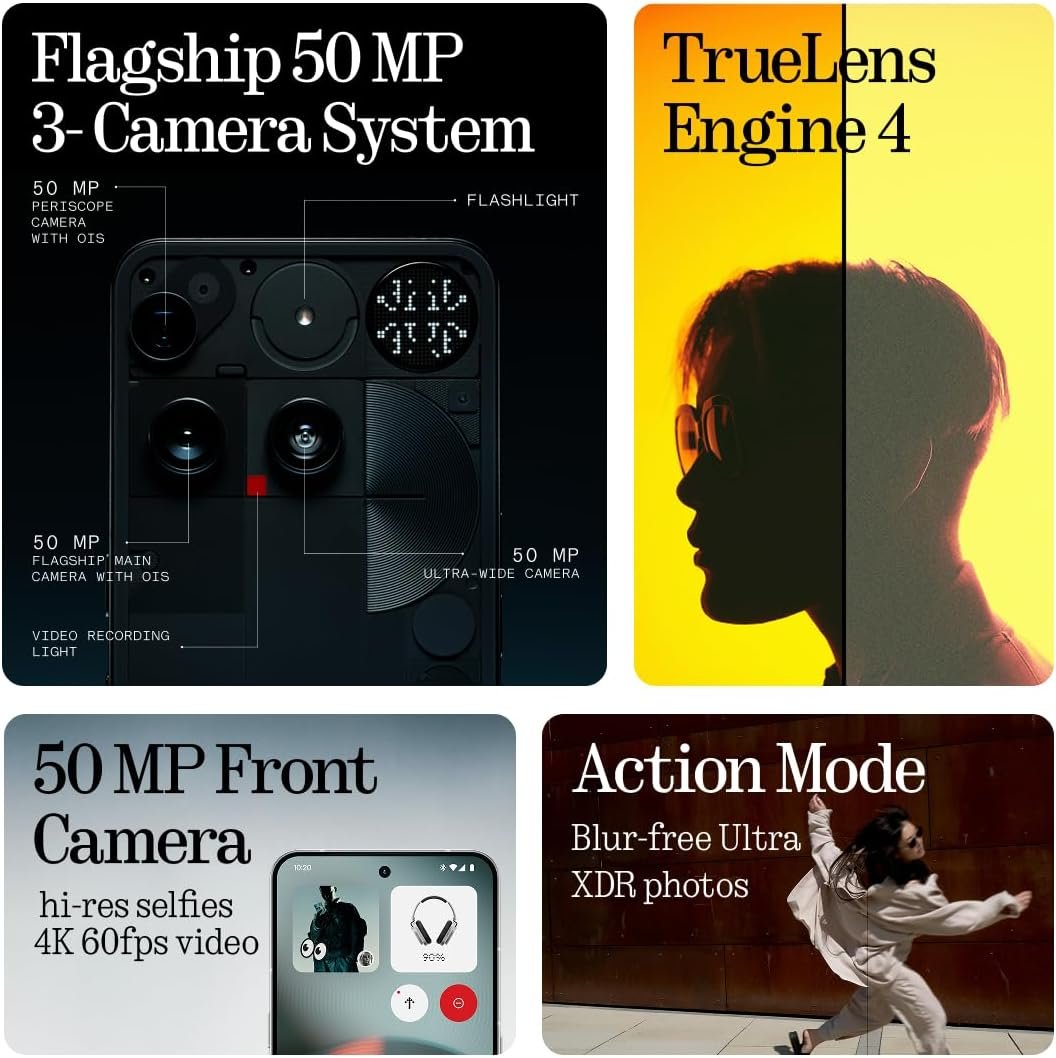 Three 50MP cameras on the back and a 50MP selfie camera. Image: Nothing.
Treat a business phone’s camera as a documentation tool. You need readable serial numbers, product photos that don’t need editing, and damage photos that will hold up in an insurance claim.
The Nothing Phone (3) has a 50MP main camera with OIS, a 50MP 3x periscope telephoto with OIS, and a 50MP ultrawide. Its 50MP front camera records 4K at 60fps. The 3x periscope is good for shelf labels and serial plates you can’t physically reach, and the high-resolution ultrawide captures a whole room or a whole van load in one frame. GSMArena found the telephoto “a bit noisier and softer, but still usable.”
The Pixel 11 goes further on zoom. It has a 48MP main camera, a 10.8MP 5x telephoto with OIS, and a 13MP ultrawide, and Google claims optical-quality zoom at 0.6x, 1x, 2x, 5x, and 10x. The original version of this article said neither rival offered a periscope-class zoom at this price. That was wrong for the Pixel 11, which zooms further than the Nothing. The Pixel’s selfie camera is 10.5MP and also shoots 4K/60.
The Galaxy S26 has a 50MP main camera, a 10MP 3x telephoto with OIS, and a 12MP ultrawide. It’s the only one of the three that records 8K video, and its front camera is 12MP with 4K/60.
For listings and social clips, the Nothing’s 50MP front camera stands out. For zoom, the Pixel wins. Honestly, though, a $60 light kit and a copy stand will improve your product photos more than any of these sensors. Good lighting matters more than the lens.
Speed and software support
On raw speed the Galaxy S26 wins easily. In GSMArena’s Geekbench 6 multi-core test, the US Snapdragon 8 Elite Gen 5 model scored 10,824, the Pixel 11 scored 7,429, and the Nothing scored 6,900. None of them will slow down running Square, Shopify, email, maps, and a browser. The difference shows up in games and heavy video editing, not at a register.
Software support matters more for a phone you plan to keep for years. Nothing promises five years of Android updates and seven years of security updates, counted from when the Phone (3) first went on sale on nothing.tech in July 2025. Google promises seven years of OS, security, and Pixel Drop updates for the Pixel 11, counted from August 2026. GSMArena lists the Galaxy S26 at up to seven major OS updates. If you hand phones down to staff, the Pixel and Samsung will stay supported longer.
Nothing OS is still close to stock Android, with much less preinstalled clutter than Samsung’s software. Nothing has also confirmed that the Phone (3) stays its flagship for now. CEO Carl Pei said in January that “there’s no new flagship this year,” and the company is focusing on the cheaper Phone (4a) series instead. If you’re holding out for a Phone (4), don’t expect one in 2026.
The Glyph Matrix is useful behind a counter
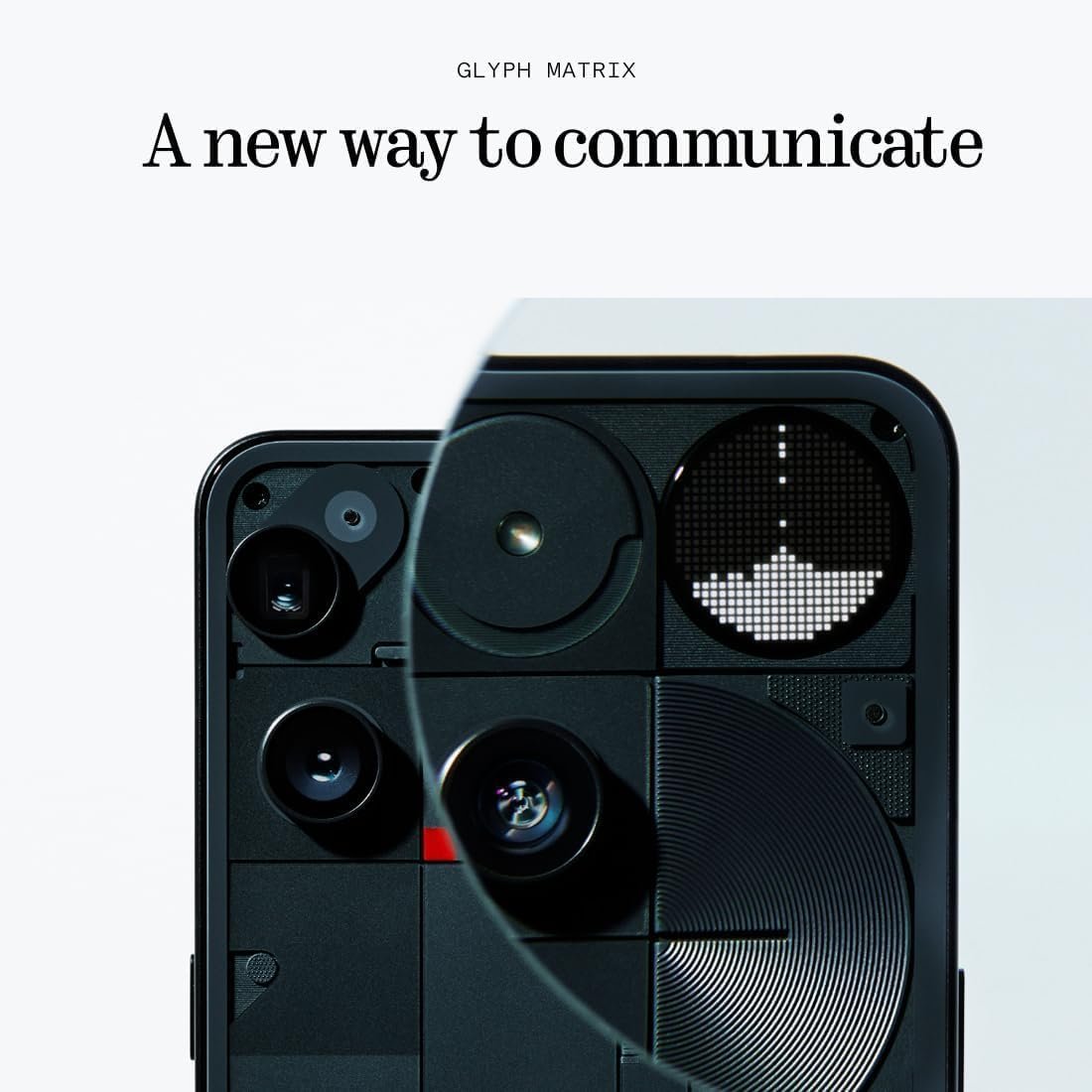 The Glyph Matrix is a 489-LED display on the back of the phone. Image: Nothing.
The Glyph Matrix is a small dot-matrix display on the back made of 489 LEDs, per GSMArena. It shows notifications, a clock, a timer, and battery level. GSMArena points out that each Nothing ringtone has its own Glyph pattern, so you can tell who’s calling even with the ringer muted.
For most people it’s a novelty. Behind a counter it’s practical: with the phone face down, you can see whether a notification is worth picking it up for, without picking it up in front of a customer. It’s a small win that adds up over forty notifications a day.
The design matters for a similar reason. If your phone sits on the counter all day, customers see it. The transparent back looks deliberate, and both rivals look like every other black rectangle. If you don’t care about that, the price already makes the case.
Will it run my register?
All three should. Square’s Tap to Pay on Android works in Square Point of Sale, Square Restaurants POS, Square Appointments, and Square Invoices. It needs Android 9 or later with NFC turned on and Developer options turned off. Square’s note is the practical test: if the Tap to Pay option shows up in your app, your phone is compatible.
Before you build a workflow around a phone as your terminal, know these three things:
- There’s no offline mode. Square says Tap to Pay on Android doesn’t support offline payments. If your internet goes down, so does contactless card acceptance, so keep a dedicated reader as a backup.
- Square for Restaurants has a much shorter device list. Square says Tap to Pay there works only on the Samsung A32 5G and A13, which means none of these three phones. Check your own app and region before you count on it.
- Don’t hand the phone over. Square’s security guidance is to have the customer tap their card to your phone, not to pass your unlocked phone across the counter. A counter stand and a passcode on the payment screen solve that.
If you’re still deciding on the POS itself, our Square vs Shopify vs building it yourself cost breakdown runs the numbers. If you’d rather use a dedicated screen than a phone, see the best budget tablets for POS and kiosks.
Who should buy which phone
- You want the most phone for the least money: Nothing Phone (3) at $549. It has the biggest screen, a 3x periscope, 256GB, and Wi-Fi 7 for $250 less than the Pixel.
- You work long days away from a charger: Pixel 11. Its tested battery life beat the Nothing’s by almost three hours, and it has magnetic wireless charging.
- You give phones to staff and keep them for years: Pixel 11 or Galaxy S26, for seven years of OS updates.
- You need a physical SIM: Nothing or Samsung. The US Pixel 11 is eSIM-only.
- You already manage Samsung devices with Knox, or you want the fastest chip: Galaxy S26, but only at a sale price.
- Your current phone lasts until 6pm and still gets security updates: keep it. Check your model’s end-of-support date before you spend anything.
What to skip
- Paying $999.99 for a Galaxy S26. That’s about $450 more than the Nothing for a smaller battery and a slower charging rating — and it’s exactly what Amazon is charging today. Wait for a sale.
- Carrier “free phone” deals. The phone is free, but the 36-month lock-in isn’t. Compare the total cost against buying unlocked once. An unlocked phone is yours to sell, hand to staff, or move to a cheaper plan.
- The 512GB tier, unless you shoot a lot of video. At these prices, 256GB plus a cheap backup server at home for product photos and receipts is the cheaper setup.
- Waiting for a Nothing Phone (4). There isn’t one coming in 2026.
Frequently asked questions
Is the Nothing Phone 3 better than the Pixel 11?
On value, yes. At $549 against about $799, it has a bigger, sharper screen, a 50MP 3x periscope, and a 50MP selfie camera. On battery life, measured brightness, zoom reach, and update length, the Pixel 11 wins. If you can afford the Pixel at its current price, it’s the better phone overall.
Nothing Phone 3 vs Galaxy S26: which should I buy?
The Nothing, unless the S26 is on sale. The S26 is faster, lighter, and gets longer software support, but at $999.99 it costs about $450 more than the Nothing. The $724.99 sale ended October 10 — wait for the next one before buying it.
How much is the Nothing Phone 3 now?
$549 for 12GB/256GB at Nothing’s US store and on Amazon as of October 12, 2026, down from its $799 launch price.
Did the Galaxy S26 go up in price?
Yes. On October 1, 2026, Samsung raised the base 256GB Galaxy S26 from $899.99 to $999.99 in the US, and the rest of the S26 range went up by $100 too. The $724.99 sale price ended on October 10; Amazon was back at $999.99 on October 12.
Which has the best battery life: Nothing Phone 3, Pixel 11, or Galaxy S26?
The Pixel 11, at 15:40 hours in GSMArena’s Active Use test. The Galaxy S26 scored 15:20 and the Nothing Phone (3) scored 12:56, even though the Nothing has the largest battery.
Does the Nothing Phone 3 really charge at 65W?
Not in GSMArena’s test, where it peaked at about 40W. It still reached 63% in 30 minutes and full in an hour, about the same as the Galaxy S26 and a bit faster than the Pixel 11.
Does the Pixel 11 have a SIM card slot?
Not the US model. Google lists it as dual eSIM. The Nothing Phone (3) and the US Galaxy S26 both take a nano-SIM plus eSIM.
How long will the Nothing Phone 3 get updates?
Five years of Android updates and seven years of security updates, counted from July 2025, when it first went on sale on nothing.tech.
Can I use these phones as a card reader?
Yes, with Square Tap to Pay on Android, as long as the option shows up in your app. There’s no offline mode, and Square for Restaurants supports Tap to Pay only on two specific Samsung A-series phones.
Is there a Nothing Phone 4?
Not in 2026. Carl Pei confirmed there’s no new flagship this year. The Phone (3) remains Nothing’s top model.
The bottom line
The Nothing Phone (3) is no longer the $799 phone that beats two $899 phones on paper. It’s a $549 phone that beats them on price, screen size, and camera count, and loses on tested battery life, measured brightness, and update length. For a small operator who wants a capable phone without paying flagship prices, that’s still a strong buy.
Get the Nothing Phone (3), 256GB, on Amazon. If you can spend $250 more, the Pixel 11 is the better all-rounder.
One last thing, and it’s what we actually do here: the phone is rarely the bottleneck. The real problem is usually that your register, your online store, your inventory, and your books don’t agree with each other, and you’re the one holding them together on a phone screen at 11pm. A better phone makes that more comfortable. It doesn’t fix it, but we can build the part that does.
Sources
6 refsAll prices and pages checked October 9, then re-checked October 12, 2026.
- GSMArena lab reviews: Nothing Phone (3) review (July 2025) for specs, $799/$899 launch prices, 1,507-nit auto brightness, 12:56h Active Use Score, ~40W peak and 63% in 30 minutes, Geekbench 6 multi-core 6,900, no LTPO, 489-LED Glyph Matrix; Pixel 11 review and spec sheet for ~2,100-nit brightness, almost 60% in 30 minutes and 1:20h full charge, 15:40h Active Use, $1,019 512GB price, Geekbench 6 multi-core 7,429; Galaxy S26 review and spec sheet for ~1,400-nit brightness, 15:20h Active Use, 62% in 30 minutes and 1:04h full charge, cameras, Geekbench 10,824, up to 7 OS updates.gsmarena.com
- Phone (3) — Nothing US: $549 price with $699 strikethrough, 5 years of Android updates and 7 years of security patches from first availability.us.nothing.tech
- Google Pixel 11 Specs — Google Store: $899 price, display, battery and charging claims, cameras and 5x telephoto, 7 years of updates, dual eSIM, Wi-Fi 6E.store.google.com
- Samsung officially raises Galaxy S26 prices by $100 — 9to5Google and Galaxy S26 256GB unlocked — Samsung US: October 1 price increase table; $999.99 list and $724.99 sale price valid through October 10.9to5google.com · samsung.com
- There won’t be a Nothing Phone 4 this year — The Verge: Carl Pei’s confirmation that the Phone (3) remains the flagship in 2026.theverge.com
- Accept payments with Tap to Pay on Android — Square Support: supported apps, Android 9+ and NFC requirements, no offline payments, Square for Restaurants device limits, security practices.squareup.com
comments
loading comments…
No comments yet. Start the thread.