
For most U.S. websites, the right call is cookieless, aggregate-first analytics — tools that never store personal identifiers, skip the consent banner entirely, and still give you the traffic data you actually need. If you run a marketing site, blog, or small e-commerce store, Plausible or Fathom cover most use cases out of the box. Need full control over your data pipeline or self-hosted infrastructure? Matomo or Umami are the serious options. Building a product with event-level depth? PostHog is the one to evaluate first.
Here’s the quick shortlist before we go deeper:
- Best for small marketing sites: Plausible (hosted SaaS, cookieless by default, under 1 KB script)
- Best for privacy-first SaaS or e-commerce: Fathom (cookieless, EU-isolated hosting, strong uptime SLA)
- Best for self-hosting: Matomo or Umami (open source, full data ownership)
- Best for product analytics with events: PostHog (open source, generous free tier, self-hostable)
- Best for mobile/IoT: TelemetryDeck (purpose-built for apps, no PII by design)
- Best for zero-cost server log analysis: GoAccess (no script, processes server logs locally)
- Best for enterprise self-hosting: Countly (open source core, enterprise plugins)
- Best for developer-native hosting: Vercel Web Analytics (zero-config on Vercel deployments)
- Best for minimal hosted setup: Simple Analytics (cookieless, GDPR-clean, EU-hosted)
The legal upside is immediate. Cookieless analytics that avoid persistent identifiers generally do not create individual records and, under common interpretations of GDPR and CCPA, do not require the consent banners that cookie-based tools trigger. That means no pop-up friction for your visitors and no consent-rate gaps in your data.
Pro Tip: If you’re ready to migrate, jump to the setup section below. If you’re still evaluating, the comparison table is your fastest path to a decision.
Key Takeaways
Cookieless, aggregate-first analytics is the right default for most U.S. websites: it removes consent banner friction, recovers traffic that consent-based tools miss, and cuts script weight in a single move.
| Point | Details |
|---|---|
| Default to cookieless tools | Plausible, Fathom, Umami, and Simple Analytics avoid persistent identifiers and typically require no cookie consent banner. |
| Self-host when data residency matters | Matomo, Umami, and PostHog are open source and deployable on your own infrastructure for full data ownership. |
| Expect session count variance | Cookieless tools count sessions differently than GA4; a 10–30% variance is normal, not a data error. |
| Audit vendor docs before buying | Confirm no raw IP storage, a documented retention window, a DPA option, and a data export path before committing. |
| Ctrlaltorion for complex setups | Custom event pipelines, server-side collection, and unified dashboards are available through Ctrlaltorion’s implementation service. |
Table of Contents
- How do privacy-friendly analytics tools compare side by side?
- What does each tool actually do, and who should pick it?
- What does “privacy-friendly” actually mean technically and legally?
- How do you pick the right privacy-first analytics tool for your site?
- What should you expect when you set up or migrate to a new tool?
- The trade-offs I see when teams actually make this switch
- Ctrlaltorion can handle the implementation for you
- Sources
How do privacy-friendly analytics tools compare side by side?
The table below covers every tool in this guide across the dimensions that actually drive the purchase decision. “Cookieless/aggregate” means no persistent identifiers and no PII collected by default. “Pseudonymized” means session-scoped hashing with no raw IP storage. “PII-capable” means the tool can collect personal data depending on configuration.
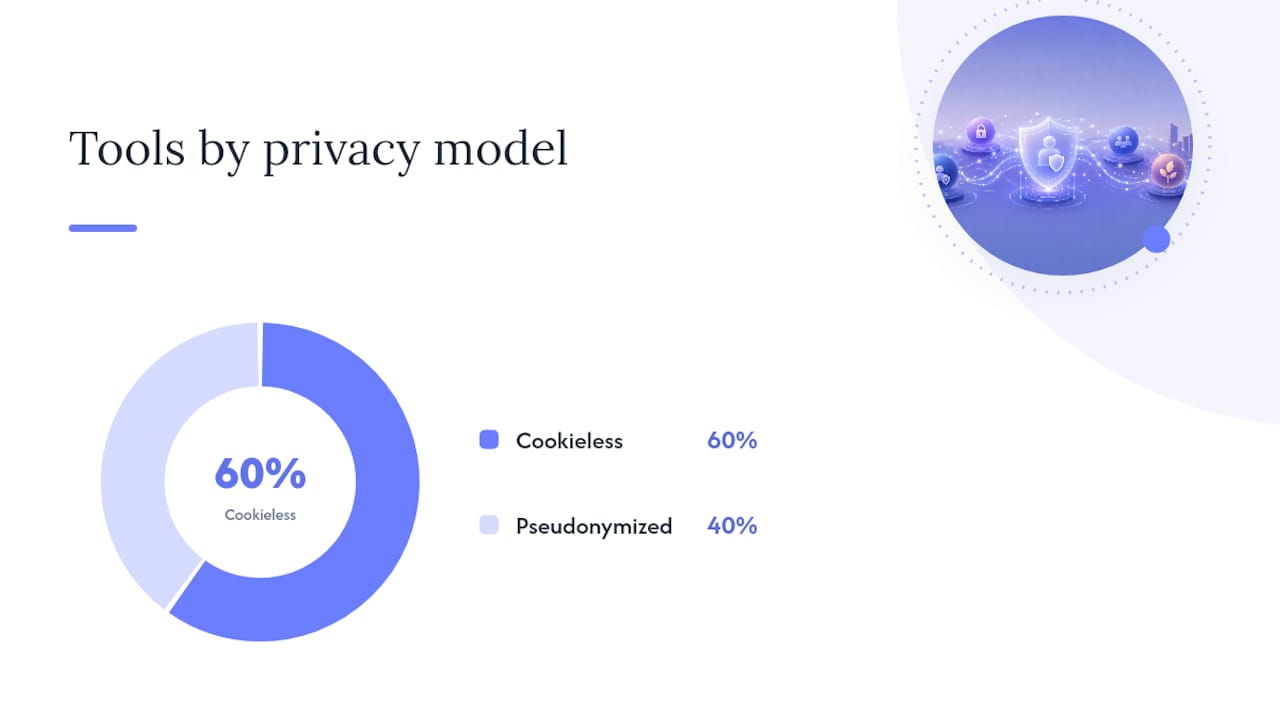
| Tool | Best for | Privacy model | Hosting | Open source? | Pricing | Key features | Data retention | Script size | Ease of setup |
|---|---|---|---|---|---|---|---|---|---|
| Plausible | Marketing sites, blogs | Cookieless/aggregate | SaaS + self-hosted | Yes (AGPL) | From $9/mo | Goals, UTM, events, funnels | Rolling 5 years (SaaS) | ~1 KB | Very easy |
| Fathom | Privacy-first SaaS, e-commerce | Cookieless/aggregate | SaaS only | No | From $15/mo | Goals, UTM, events, uptime SLA | Unlimited (paid plans) | ~2 KB | Very easy |
| Matomo | Self-hosted enterprise, compliance | Pseudonymized (configurable) | SaaS + self-hosted | Yes (GPL) | Free to use self-hosted; SaaS from $23/mo | Full funnel, heatmaps, goals, UTM, A/B | Configurable | ~22 KB | Moderate |
| PostHog | Product analytics, SaaS teams | Pseudonymized (configurable) | SaaS + self-hosted | Yes (MIT/EE) | Free to use up to 1M events/mo | Events, funnels, session replay, feature flags | 1 year (free tier) | ~35 KB | Moderate |
| Umami | Developers, self-hosting | Cookieless/aggregate | SaaS + self-hosted | Yes (MIT) | Free to use self-hosted; SaaS from $9/mo | Events, UTM, goals, multi-site | Configurable | ~2 KB | Easy |
| Simple Analytics | Small sites, GDPR-clean | Cookieless/aggregate | SaaS only | No | From $9/mo | Goals, UTM, events, import from GA | 6 months–unlimited | ~3 KB | Very easy |
| Vercel Web Analytics | Vercel-hosted sites | Cookieless/aggregate | SaaS (Vercel) | No | Free to use tier; Pro plan available | Page views, referrers, Web Vitals | 30 days (free) | ~1 KB | Zero-config |
| Countly | Enterprise, mobile, IoT | Pseudonymized (configurable) | SaaS + self-hosted | Yes (AGPL) | Free to use community; Enterprise custom | Events, push, crash reports, funnels | Configurable | ~15 KB | Moderate |
| GoAccess | Developers, server log analysis | No script/no PII | Self-hosted only | Yes (MIT) | Free to use | Real-time log parsing, geo, referrers | Depends on log retention | No client-side footprint (no script) | Technical |
| TelemetryDeck | iOS/macOS/Android apps | Cookieless/aggregate | SaaS | No | Free to use up to 100K signals/mo | App events, retention, funnels, crash signals | 1 year (free tier) | SDK-based | Easy |
Trust signals worth noting:
- Plausible, Matomo, Umami, PostHog, Countly, and GoAccess publish their full codebases on GitHub, so you can audit exactly what runs on your site.
- Fathom and Simple Analytics publish detailed privacy policy and data-handling docs and explicitly state EU-isolated data storage.
- Matomo’s privacy documentation covers data classification, minimized access, and auditable storage as part of a broader compliance posture — not just the analytics script itself.
- PostHog and Countly have SOC 2 Type II certifications on their cloud offerings (verify current status on their respective security pages, as certifications are renewed annually).
- Removing consent management bundles and heavy tracking scripts reduces third-party script weight and latency, which directly improves Core Web Vitals scores.
What does each tool actually do, and who should pick it?
Plausible
Plausible is the go-to for site owners who want clean traffic data without touching a cookie or a consent banner. The script weighs under 1 KB, installs in one line, and the dashboard is genuinely readable by non-technical stakeholders.
- Cookieless by default; daily-rotating identifiers prevent cross-session tracking
- Goals, custom events, UTM attribution, and funnel tracking included
- SaaS hosted in the EU; self-hosted option available via Docker
- Pricing starts at a low monthly rate suitable for small sites
- Who it’s for: Marketing teams, bloggers, and small business owners who want a Google Analytics replacement with zero compliance overhead
Running alongside GA4 is straightforward: install both scripts and compare counts during a validation window.
Fathom
Fathom’s differentiator is its uptime SLA and EU-isolated infrastructure. It’s the tool to reach for when your legal team is asking pointed questions about data residency.
- Cookieless, no IP storage, no cross-site tracking
- Hashing and salting of session attributes pseudo-anonymize sessions without storing PII
- SaaS only; no self-hosted option
- Pricing starts at a moderate monthly rate with unlimited data retention on paid plans
- Who it’s for: SaaS founders, e-commerce operators, and anyone with EU customer exposure who needs a documented privacy posture
Fathom cannot be self-hosted, so if data sovereignty on your own servers is a hard requirement, look at Matomo or Umami instead.
Matomo
Matomo is the most feature-complete open-source option. Self-hosted, it gives you full ownership of every row of data. The trade-off is setup complexity and ongoing server maintenance.
- Configurable privacy settings: IP anonymization, cookieless mode, data purging
- Full funnel analysis, heatmaps, A/B testing, goals, and UTM attribution
- Self-hosted (free, GPL license) or SaaS pricing starts at a tiered monthly rate
- Compliance documentation covers data classification and access controls, treating analytics as part of a wider data lifecycle
- Who it’s for: Organizations with strict data residency requirements, compliance teams, or developers who need GA-feature parity under full self-control
Matomo’s ~22 KB script is heavier than Plausible or Fathom. Budget for that in your performance audit.
PostHog
PostHog is product analytics, not just web analytics. If you need session replay, feature flags, A/B testing, and event pipelines alongside page-level data, it’s the only open-source tool in this list that covers all of it.
- Open source (MIT/EE hybrid); self-hostable on your own infrastructure
- Free to use tier covers a generous number of events per month on the cloud
- Pseudonymized by default; configurable for stricter no-PII modes
- Session replay, funnels, cohorts, feature flags, and A/B testing built in
- Who it’s for: Product teams at SaaS companies or startups who need behavioral depth, not just traffic counts
PostHog’s script (~35 KB) is the heaviest in this list. For pure marketing-site analytics, that overhead is hard to justify.
Umami
Umami is the lean self-hosted alternative for developers who want Plausible-level simplicity with full data ownership and no monthly SaaS fee.
- Cookieless, no PII collected by default
- MIT license; deploy on any Node.js host or via Docker in under 30 minutes
- SaaS option available with affordable monthly pricing if self-hosting isn’t feasible
- Supports custom events, UTM parameters, goals, and multi-site tracking
- Who it’s for: Developers comfortable with a Node.js/PostgreSQL stack who want zero ongoing cost and complete data control
Simple Analytics
Simple Analytics measures visits without cookies, visitor IDs, or IP storage, which means it captures traffic that GA4 loses when visitors decline consent. That “hidden traffic” recovery is its clearest selling point.
- EU-hosted SaaS; no self-hosted option
- Cookieless by design; GDPR and CCPA compliant per vendor docs
- GA import tool, UTM support, and a public dashboard option
- Pricing starts at an entry-level monthly rate; data retention varies by plan
- Who it’s for: Small site owners who want the simplest possible setup and a clean compliance story
Vercel Web Analytics
If your site already runs on Vercel, this is a zero-config win. No script to install manually, no third-party domain, and Web Vitals data baked in.
- Cookieless, no PII, no persistent identifiers
- Integrated directly into the Vercel dashboard; no separate account needed
- Free to use tier retains data for a limited period; paid plans offer extended retention
- Who it’s for: Developers deploying on Vercel who want baseline traffic data without any additional tooling
Outside Vercel, it has no value. Don’t evaluate it for non-Vercel stacks.
Countly
Countly targets enterprises and mobile/IoT teams that need event tracking across web, mobile, and connected devices under a single platform.
- Open source community edition (AGPL); enterprise plugins add push notifications, crash reporting, and advanced segmentation
- Self-hosted or SaaS; Enterprise pricing is available upon request
- Configurable privacy settings; pseudonymized by default
- Who it’s for: Enterprise teams or mobile-first products that need cross-platform analytics under one roof
GoAccess
GoAccess parses your existing server logs. No JavaScript, no script on your site, no third-party requests — just your own log files analyzed locally.
- Zero client-side footprint; processes Apache, Nginx, or Caddy logs
- Real-time terminal dashboard or exportable HTML report
- Free to use and open source (MIT); runs entirely on your server
- Who it’s for: Developers and sysadmins who want traffic data with zero client-side exposure and no SaaS dependency
The limitation is obvious: GoAccess sees only what your server logs, so bot filtering and referrer spam require manual configuration.
TelemetryDeck
TelemetryDeck is purpose-built for app developers — iOS, macOS, Android, and web — who need usage analytics without collecting any PII.
- Cookieless, no persistent identifiers; signals are hashed before transmission
- Free to use up to 100,000 signals per month; paid tiers for higher volume
- SDKs for Swift, Kotlin, JavaScript, and more
- Who it’s for: App developers who need lightweight, privacy-safe usage metrics and don’t want to build their own telemetry pipeline
What does “privacy-friendly” actually mean technically and legally?
“Privacy-friendly analytics” is the informal term; the industry standard framing is privacy-by-design analytics or cookieless analytics. The two terms overlap but aren’t identical, and the distinction matters for compliance.
The core technical patterns are:
- No persistent identifiers: No cookies, no local storage, no fingerprinting. Each page load is counted independently.
- Rotating/session-limited identifiers: Some tools (Plausible, Fathom) generate a temporary hash from session attributes — browser type, screen size, IP fragment — that resets daily, making cross-session user paths impossible by design.
- Hashing and salting: Fathom’s approach pseudo-anonymizes sessions by hashing a combination of session signals with a rotating salt, so no raw IP or device fingerprint is ever stored.
- Server-side collection: Some configurations process requests at the server before they reach the browser, eliminating client-side script exposure entirely.
- No IP storage: A hard requirement for most GDPR-clean configurations. Storing raw IPs, even briefly, can constitute personal data processing under EU law.
The legal effect is significant. Under common interpretations of GDPR’s ePrivacy Directive and CCPA’s definition of personal information, analytics that avoid persistent browser storage and do not create individual records generally fall outside the consent requirements that apply to cookie-based tracking. That’s why Plausible, Fathom, and Simple Analytics can credibly claim their users don’t need a cookie consent banner — the data simply isn’t personal data in the legal sense.
A practical caution: “Generally exempt” is not a universal guarantee. CCPA’s definition of personal information is broad, and some state privacy laws (Virginia’s CDPA, Colorado’s CPA) have their own thresholds. If you serve EU residents or operate in a heavily regulated sector (healthcare, finance), have your legal counsel review the specific tool’s data handling docs before removing your consent banner entirely.
Pro Tip: When evaluating any tool, ask the vendor three specific questions: (1) Do you store raw IP addresses at any point, even temporarily? (2) How often do session identifiers rotate? (3) Can you provide a Data Processing Agreement (DPA) for GDPR purposes? A vendor that can’t answer all three clearly is a red flag.
True compliance goes beyond swapping the analytics script. Matomo’s compliance guidance frames analytics as one component of a broader data lifecycle that includes data classification, minimized access, and auditable storage. Replacing GA4 with Plausible doesn’t automatically make your site compliant if you’re still running third-party ad pixels, session replay tools, or CRM integrations that collect PII through other vectors.
The performance upside is real and measurable. Removing consent management platforms and heavy tracking scripts cuts third-party script weight and reduces latency, which feeds directly into Largest Contentful Paint and Total Blocking Time — two Core Web Vitals that affect both user experience and search rankings.
How do you pick the right privacy-first analytics tool for your site?
Work through this in order. It takes 10 minutes and eliminates most of the noise.
- Do you need to own your data on your own servers? If yes, your shortlist is Matomo, Umami, PostHog, Countly, or GoAccess. If no, any SaaS option works.
- What’s your traffic scale? Under 100K pageviews/month: any tool handles it. Over 1M events/month: verify pricing tiers carefully — PostHog’s free tier covers 1M events, Plausible’s pricing scales by pageview volume.
- Do you need product-level event depth (funnels, session replay, feature flags)? PostHog is the answer. For pure traffic and marketing attribution, Plausible, Fathom, or Simple Analytics are sufficient.
- Do you have EU data residency requirements? Fathom and Simple Analytics explicitly offer EU-isolated hosting. Matomo self-hosted gives you full control. Verify Plausible’s current EU hosting configuration in their docs.
- What CMS or framework are you on? Plausible, Umami, and Matomo have official plugins for WordPress, Ghost, and Webflow. Vercel Web Analytics is zero-config on Vercel. GoAccess requires server log access.
- What’s your budget? GoAccess and Umami (self-hosted) are free. Plausible, Simple Analytics, and Umami SaaS start at $9/month. Fathom starts at $15/month. Matomo SaaS starts at $23/month. PostHog and Countly enterprise are custom.
Vendor questions to ask before signing:
- What is your exact data retention window, and can I configure it?
- Can I export raw event data (CSV, API, or database dump)?
- Do you offer a Data Processing Agreement for GDPR compliance?
- What are your SLA uptime guarantees and support channels?
- Do you hold SOC 2 Type II or ISO 27001 certification? (Verify current status directly.)
- What is your refund or trial policy?
Red flags that should stop a purchase:
- Vendor stores raw IP addresses without anonymization
- No documented data retention policy or no way to configure it
- No export path for your data (vendor lock-in risk)
- Cross-site tracking IDs or third-party data sharing in the privacy policy
- No DPA available for GDPR-covered organizations
Matomo’s privacy documentation is a useful benchmark for what thorough vendor transparency looks like — independent audits, retention windows, and exportability documented in one place.
What should you expect when you set up or migrate to a new tool?
Migration is where most teams underestimate the effort. Here’s the realistic sequence:
- Install the new script in parallel with GA4. Run both for at least two to four weeks before cutting over. Don’t skip this step.
- Verify event firing. Use the tool’s real-time view or debug mode to confirm page views, goal completions, and custom events are recording correctly.
- Map your UTM parameters. Confirm your existing campaign URLs pass through correctly. Most cookieless tools support standard UTM parameters natively.
- Set your data retention window. Configure this before traffic accumulates — retroactive changes may not apply to existing data.
- Test on staging first. Deploy to a staging environment, run through your key user flows, and confirm no script conflicts with your CMS or tag manager.
- Document the cutover date. Your historical GA4 data and your new tool’s data will never be directly comparable. Note the date so future reports don’t mix the two baselines.
Common migration pitfalls:
- Session/visitor logic differs. Cookieless tools count sessions differently than GA4’s cookie-based model. Expect a 10–30% variance in reported sessions — this is normal, not a bug.
- Cross-session funnels disappear. Daily-rotating identifiers make multi-session user paths impossible by design. Redesign your funnel analysis around session-scoped events instead.
- Bot filtering varies. GoAccess and self-hosted Matomo require manual bot filter configuration. SaaS tools like Plausible and Fathom handle this automatically.
- Hidden traffic recovery surprises teams. Cookieless tools often report higher visit counts than GA4 because they capture traffic that GA4 loses when visitors decline consent. That’s not inflation — it’s accuracy.
Integration notes: Plausible and Matomo both offer Search Console integration. Most tools support UTM parameters natively. For WordPress, official plugins exist for Plausible, Matomo, and Simple Analytics. Server-side collection (proxying the analytics script through your own domain) is available for Plausible, Fathom, and Matomo, and it bypasses most ad blockers.
When to bring in a developer: Multi-domain setups, custom event pipelines, server-side collection configuration, and e-commerce revenue tracking all add meaningful complexity. If you’re running a custom-built app, need a unified analytics dashboard across multiple data sources, or want to automate data export and archival, that’s the point where a custom implementation saves time and prevents data loss.

Pro Tip: Before you cut over fully, export a historical summary from GA4 (sessions, top pages, top referrers, conversion events) as a CSV. Store it. You’ll want that baseline six months from now when someone asks why the numbers look different.
The trade-offs I see when teams actually make this switch
Most teams approach privacy-first analytics as a compliance checkbox. They swap GA4 for Plausible, remove the cookie banner, and call it done. That’s not wrong, but it misses the more interesting trade-off.
What you lose is user-level path data. You can no longer follow a specific visitor across three sessions, identify which channel drove a conversion two weeks after the first touch, or build cohorts based on behavioral history. For content sites and marketing pages, that loss is largely theoretical — most teams never used that data meaningfully anyway. For product teams tracking activation funnels or churn signals, the loss is real and requires a deliberate redesign of your event schema to compensate with session-scoped signals.
What you gain is more than compliance. The performance improvement from dropping a consent management platform and a 45 KB GA4 script is tangible. Aggregate data is also cleaner — no consent-rate gaps, no bot inflation from misconfigured filters, no sampling on high-traffic pages.
My honest read: self-hosting makes sense when you have a dedicated DevOps resource, a compliance requirement that mandates data residency on your own infrastructure, or a traffic scale where SaaS pricing becomes painful. The measurement mindset shift — from user journeys to aggregate event design — is the real work, and no tool does that for you.
Ctrlaltorion can handle the implementation for you
Custom analytics integration is one of the more underestimated engineering tasks. The script install is five minutes. Getting server-side collection, multi-domain tracking, custom event pipelines, and a unified dashboard that pulls from your analytics tool, your CRM, and your e-commerce platform — that’s a different project entirely.

Ctrlaltorion builds exactly these kinds of implementations for small businesses and developers who don’t want to spend weeks debugging data pipelines. A typical engagement runs from an initial audit of your current tracking setup through plan, implementation, QA, and handoff — with working dashboards and documented data flows at the end, not just a script tag in your header. Services include privacy-first analytics integration, server-side collection configuration, custom dashboards, export and archival automation, and workflow integrations that connect your analytics data to the tools your team already uses.
If you’re evaluating a migration or need a custom setup that goes beyond what a SaaS tool’s UI can handle, get in touch with Ctrlaltorion for a scoped estimate or a discovery call.
Sources
5 refsThese are the primary vendor and standards documents referenced throughout this guide. Each one is worth reading before you finalize a tool choice.
- Cookieless web analytics: accurate data without the consent banner | Plausible Analyticsplausible.io
- Simple Analyticssimpleanalytics.com
- Cookieless Analytics for the Privacy-First Web: Fathom Analyticsusefathom.com
- Web Analytics User-Privacy Protected - Matomomatomo.org
- Plausible Analytics | Simple, privacy-friendly Google Analytics alternativeplausible.io
comments
loading comments…
No comments yet. Start the thread.