The hardware bar for running genuinely capable AI is collapsing, and it’s collapsing toward machines small businesses already own. This is what that actually means for your API bill and your workflow — with honest caveats on what you give up.
Something quietly significant happened in the last week of July and the first week of August. Three unrelated projects, from three unrelated teams, put serious open-weight AI models on hardware nobody thought could run them a year ago.
On August 3, a project called Swiftlet demonstrated an 80-billion-parameter Qwen model running in 4.3 GB of RAM on a Mac — and a 35-billion-parameter version running on an iPhone. On July 29, a project quantized Gemma 4 26B into a footprint that runs in about 2 GB. On August 4, someone published a working setup for DeepSeek V4 Flash on a single MI300X GPU. Cloudflare, in the same window, published a blog post about running open-weight Kimi and GLM models in production at scale, using the phrase “smaller, faster, safer” to describe why.
Any single one of these would be a fun tech demo. Three in a week, plus a large infrastructure company publicly committing to open-weight models in production, is not a demo. It’s a trendline. The direction of that trendline matters for anyone paying an AI API bill every month, because it is the specific direction of “your API bill is not necessarily a permanent line item.”
I want to be careful not to overclaim this piece. Nobody is telling you to cancel your OpenAI subscription tomorrow. Some of your workflows will run great locally today. Some genuinely won’t, and the honest math about which is which is what this piece is for. What has changed is that the question is now real for a small business — a year ago the answer was “you can’t run useful models locally on hardware you can afford,” and today the answer is a much more interesting “you can, for these tasks, at these tradeoffs, and here’s the crossover point.” Let’s do that math.
How on earth do you fit 80 billion parameters in 4 GB
You don’t, actually — not in the sense of “the whole model is sitting in memory the way an 8 GB model does.” What Swiftlet and projects like it do is a combination of aggressive quantization and streaming weight loading from SSD. Both deserve a plain-English explanation, because the tradeoffs they introduce are exactly what determines whether local inference is a fit for your specific job.
Quantization is the process of storing model weights at lower precision than the model was originally trained at. Full-precision weights are 16 or 32 bits each. Quantized weights can be 4 bits, 3 bits, or even 2 bits. The math is exactly what it sounds like: you’re storing less information per weight, and you’re trading off some model quality to fit dramatically more parameters into the same memory footprint. Modern quantization techniques have gotten remarkably good — the quality loss at 4 bits is often almost imperceptible on most real workloads, and the quality loss at 3 bits is task-dependent but frequently acceptable. Below 3 bits things get more interesting and the honest answer is “it depends on your task.”
Streaming from SSD is the second trick. Instead of holding the entire model in RAM, the inference engine keeps most of the weights on disk and pages them in and out of memory as different layers are needed for computation. Modern NVMe SSDs are fast enough that this works — you take a hit on tokens per second, but you can run a model whose full size is many times larger than your available RAM. The Swiftlet-style setups pair aggressive quantization with streaming, and the combination is what makes a nominally 80B model runnable on 4.3 GB of physical memory. It’s slow — you’re not going to get GPT-4-style latency out of it — but it runs, and it produces coherent, useful output for a wide range of tasks.
The important honest thing to name: you are giving up some throughput and some quality relative to a hosted API on the same base model. Anyone who tells you local inference is free of tradeoffs is selling something. What the current wave of projects has done is push the tradeoff frontier out far enough that a lot of previously-uneconomic use cases are now on the near side of it.
Which tasks tolerate this, honestly
The quality question is task-dependent, and being honest about that is more useful than blanket claims either way. Here’s how to think about it.
Tasks that tolerate aggressive quantization well. Classification (is this ticket about billing, technical, or account?). Extraction (pull the invoice number, the amount, and the due date out of this email). Summarization (turn this three-page contract into a five-bullet brief). First-draft generation (write a starting draft I’ll edit). These are jobs where “close to right” is worth a lot and where a human reviews the output anyway. They run beautifully on quantized local models today, at a level of quality that would have required a hosted API call a year ago.
Tasks that hold up okay. Q&A over your own documents (retrieval-augmented generation where the model is mostly stitching together retrieved content). Structured output (JSON generation against a defined schema). Translation between common language pairs. Code generation for well-scoped tasks with clear specs. These are jobs where local models are noticeably behind the very best hosted models, but the gap is small enough that the cost/privacy tradeoff often favors local for a small business.
Tasks where local models still meaningfully lag. Long-context reasoning over hundreds of thousands of tokens (the frontier hosted models are still ahead here in ways that matter for some workflows). Cutting-edge coding assistance on novel or complex problems (the difference between a top hosted model and a good local model is real for hard programming work). Anything requiring the very latest world knowledge (local models are frozen at their training cutoff; hosted models often have retrieval or more recent updates). Multi-step agent workflows with many tool calls (the reliability gap is still meaningful).
The rough rule: the more your task looks like “process this specific input in a specific way and give me a specific output,” the better local inference performs. The more your task looks like “figure out what to do in a novel situation with lots of context,” the more the hosted frontier still earns its price.
For most small businesses, the volume of AI use falls heavily into the first bucket. Email triage, document Q&A, drafting, extraction, summarization, and classification are the day-in-day-out workload. The novel-reasoning tasks are real but usually a small fraction of total calls. That distribution is what makes the local-inference story economically interesting.
The small-business math, worked out
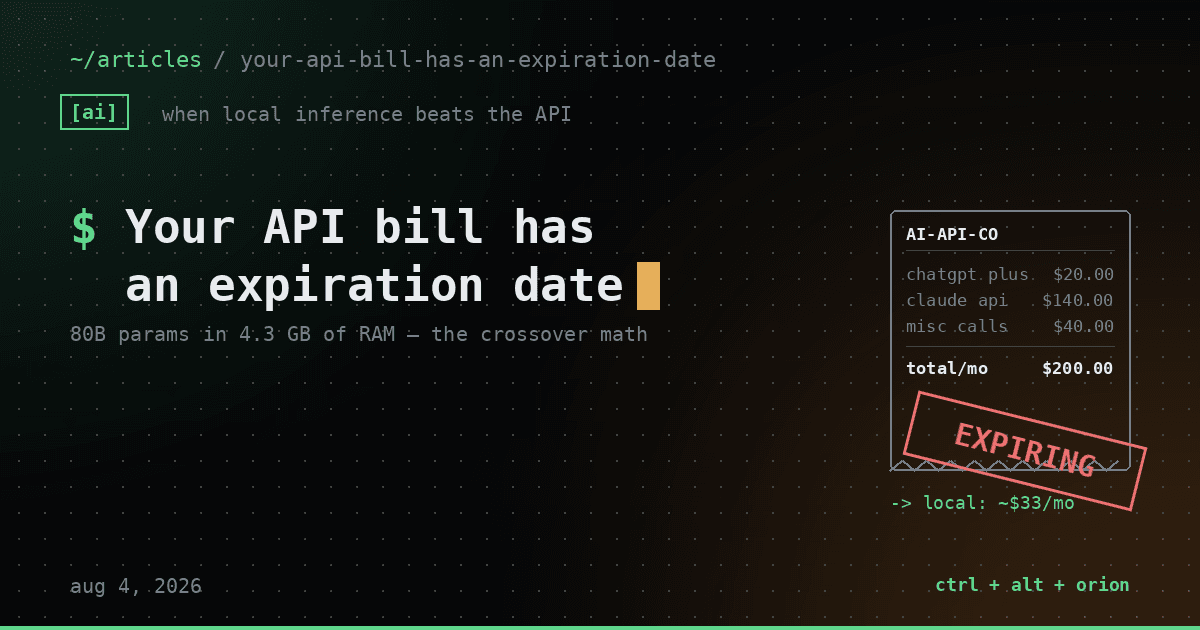
Let’s do a specific example, because abstract cost comparisons are useless. Take a small business making moderate use of a hosted AI API — say, $200/month across ChatGPT/Claude subscriptions and API calls, which is a common figure for a five- to ten-person operation using AI seriously but not intensively. That’s $2,400/year. In three years, $7,200. In five years, $12,000.
A Mac Mini configured with enough RAM to run good local models for that team’s needs — a mid-tier Apple Silicon machine with 32 or 64 GB of unified memory — is somewhere around $1,500 to $2,500 out the door. Call it $2,000 for a plausible middle. If it lasts five years (Apple Silicon machines generally do), amortized that’s $400/year, or about $33/month.
The crossover point, in the most favorable version of this math, is roughly year one. In the least favorable version — where you need a chunkier machine, or you need to run some workloads on hosted APIs because local isn’t good enough, or you factor in the setup time — the crossover point stretches to maybe eighteen months to two years, depending on your actual usage.
Both of those crossover points are much shorter than the useful life of the hardware. That’s the actual interesting fact. In every version of this math I can construct, the total cost of ownership of a local inference setup is lower than the equivalent hosted API spend within two years, and dramatically lower over five.
That doesn’t mean you should switch. It means you have real optionality that you might not know you have. And it means the API vendors are going to spend the next two years fighting very hard to keep you on the hosted side of that math, through better models, better products, and better bundling. The competitive dynamic between hosted and local is going to be one of the most interesting ongoing stories in small-business AI for the next couple of years, and being aware that the local side of the ledger is now real changes how you should evaluate every new hosted-tier price change.
Cloudflare’s tell
The Cloudflare piece deserves a specific mention. When a company operating at planetary scale — hundreds of millions of requests per day, with cost-per-inference optimization as an existential business concern — publishes that they are running open-weight models like Kimi and GLM in production and describes them as “smaller, faster, safer,” that is a signal about production-readiness that individual demos aren’t.
Cloudflare doesn’t put things in production because they’re neat. They put things in production because the math works. The fact that open-weight models have crossed the bar for their internal reliability, quality, and cost thresholds is a data point that they’ve crossed the bar for a lot of smaller operators too — because Cloudflare’s bar for “good enough to run in production” is meaningfully higher than a typical small business’s bar. If it works for them at scale, it certainly works for you at your scale, for the tasks that fit.
The other piece of the Cloudflare signal: “smaller” and “faster” are code for “we don’t need the biggest most expensive model for most jobs.” That is exactly the intuition small businesses should be building. The right question isn’t “which model is best?” It’s “what’s the smallest, cheapest model that does this specific job to my quality bar?” Answered honestly, that question puts a lot of jobs onto local hardware immediately.
A starter setup that actually makes sense
If you want to move one workflow local as a real experiment — not a demo, an actual thing your team uses in real work — here’s the shape of a plan that has the highest chance of success.
Pick the right first workflow. The best candidate is a high-volume, low-stakes-per-call task where privacy matters and per-call latency isn’t critical. Internal document Q&A over your policies, handbook, or procedure docs is close to ideal. Email triage — classifying incoming customer messages into buckets — is another good fit. Draft summarization of client meetings, transcripts, or long PDFs is a third. Avoid your most critical, most novel, or most latency-sensitive workflow for the first try. You’re building confidence and a baseline.
Buy or repurpose the right hardware. A recent Mac Mini or a similarly-specced small workstation with 32 GB of unified memory and a fast SSD is the sweet spot for a small business today. If you’re a Linux shop, a small workstation with a used server-grade GPU (or even without one, for smaller models) is competitive. You do not need to buy the newest thing. You do not need multi-GPU rigs. This is a $1,500–$3,000 decision, not a $30,000 decision.
Use a mainstream local inference stack. On Mac, MLX is currently doing the most interesting work. On Linux, llama.cpp and its ecosystem are the reliable default. There are graphical wrappers if you don’t want to touch the command line. Ollama and LM Studio are common on-ramps. Pick one, stick with it long enough to actually learn it, and be willing to switch if the ecosystem’s center of gravity moves — which it will, more than once.
Start with a small, well-known open model. Not the most exotic new release. A Llama, Qwen, Mistral, or Gemma in the 7B–13B range is the right starting point for most first workflows. It fits comfortably in modest RAM, runs at usable speed, and has enough community documentation that when things go weird, you can find the answer. Once you have one workflow running well, you can experiment with larger models for jobs that need more capability.
Measure honestly. Run the same workflow through your local setup and through your hosted API side-by-side for a week. Look at real outputs. Ask your team which they prefer. Time the round trips. Add up the costs. You are gathering data, not proving a thesis. Sometimes local wins. Sometimes hosted wins for that specific job. Both answers are useful, and they will vary by task.
Keep the hosted API around. This is a hybrid strategy, not a religious conversion. The right end state for most small businesses in 2026–2027 is a portfolio: local inference for high-volume routine work where the privacy and cost benefits stack up, hosted API for the small number of novel or critical tasks where the frontier still matters. Anyone who tells you it has to be all one or the other is not thinking about your business, they’re thinking about their vendor loyalty.
What could change this story
I want to name the ways this analysis could be wrong, because the honest version of any strategy piece names its counterfactuals.
Hosted APIs could get dramatically cheaper. If the price of frontier-model inference collapses — which it has been doing steadily — the crossover math shifts toward hosted. This is worth watching, but “dramatically cheaper” has to compete with “free after hardware amortization,” which is a very hard number to beat on the pure cost dimension. The privacy and control dimensions don’t shift either way.
A hosted vendor could bundle inference into something you’re already paying for. Microsoft, Google, and Apple are all in positions to make hosted AI feel free by baking it into products you already buy. If the AI you need is included in Microsoft 365 or Google Workspace at no marginal cost, the math changes. Watch what gets bundled.
Open-weight model quality could plateau. This is the pessimistic scenario for local inference — if the open-weight side stops closing the gap with frontier hosted models, the tasks that require frontier quality stay on hosted forever. This is possible, but the current evidence points the other direction: the open-weight frontier has been closing the gap on hosted quality at a striking pace for two years running.
Your business’s task mix could genuinely require frontier reasoning. Some businesses’ AI use is actually dominated by novel-reasoning, long-context, multi-step-agent tasks where the frontier hosted models really do earn their price. That’s a real category. If you’re in it, this whole analysis matters less to you. Most small businesses aren’t in it, but you should look at your actual task mix honestly rather than assume.
The bottom line
The API bill is not permanent. It’s a lease on capability that, for a growing fraction of practical business AI use, you can now own outright with a few thousand dollars of hardware you were probably going to buy in the next hardware refresh cycle anyway. That doesn’t mean everyone should switch. It means the switch is now a real, defensible option for a lot of workflows, and that fact alone changes your negotiating position with every hosted vendor you buy from.
The interesting move for a small business in the second half of 2026 is not to migrate everything, and not to ignore the trend either. It’s to move one workflow to local as a real experiment, measure it honestly, and use what you learn — about your task mix, your team’s tolerance for latency, your privacy needs, your actual crossover math — to make better decisions for the next two years’ worth of AI purchasing.
The teams that will look prescient in 2028 aren’t the ones running the newest hosted models. They’re the ones who quietly built the local footprint alongside them, so that whichever way the market moves — hosted gets cheaper, hosted gets more restrictive, hosted gets bundled, open-weight keeps closing the gap, all of the above at once — they have options. That’s the whole trick. Optionality, bought cheaply, before the market forces you to have it.
Sources
5 refs- Swiftlet — 80B Qwen on Mac in 4.3 GB RAM, 35B on iPhone, published August 3, 2026. Primary source for the extreme quantization demonstration.github.com
- turbo-fieldfare / related project — Gemma 4 26B in 2 GB RAM, July 29, 2026 (~1 week old at publication). Primary source for the mid-range quantization demonstration.github.com
- DeepSeek V4 Flash single-GPU setup — repository published August 4, 2026, cited for the single-GPU-for-serious-model claim.
- Cloudflare — blog on production open-weight inference with Kimi and GLM, August 3, 2026. Primary source for the “big infra endorses open-weight” signal.blog.cloudflare.com
- llama.cpp, MLX, Ollama, LM Studio project documentation, as of August 2026, for the practical inference stack recommendations.
Freshness blip: primary demonstrations cited are one to seven days old at publication. The crossover-math conclusions are intended to hold across the current hardware and pricing regime; the direction of the trend has been consistent for eighteen months and the mechanism (open-weight quality closing the gap; consumer hardware improving) is durable.
comments
loading comments…
No comments yet. Start the thread.